Showing posts with label A Ride Through Our History. Show all posts

Wednesday, January 13, 2016

Motorcycling in Canada - A Ride Through our History - Part 11


Suzuki entered the Canadian market in 1973 alongside Yamaha and Kawasaki. Having started producing motorcycles in 1952, it only took them 10 short years to break onto the racing circuits in a meaningful way.

Suzuki built its first motorized bicycle, the ’Power Free’, it was designed to be inexpensive and easy to maintain, it used a 36cc, two-stroke engine clipped to the frame of a conventional bicycle.

The Power Free’s unique double sprocket gear system allowed riders to pedal without engine assistance, with engine assistance, or to travel completely under the engine’s own power.  The Power Free was followed by a number of renditions, namely the Diamond Free and the Mini Free.


During the 50's and into the early 60's Suzuki produced a motorcycle called the Colleda which was sold primarily in Japan until the late 50's.

Suzuki became the first Japanese manufacturer to win a motocross world championship when Belgium born racer Joel Robert won the 1970 250 cc title. In the 1970's, Suzuki established themselves in the motorcycle racing world with both British born racer Barry Sheene and Belgium born racer Roger De Coster winning world championships in the premier 500 cc division in road racing and motocross respectively.

Suzuki changed the face of motorcycling and motorcycle racing in a very meaningful way.

Suzuki was the first motorcycle manufacturer to utilize a design house to design a motorcycle.
The GSX1100S Katana was that bike  designed by the Target Design Team.

When they introduced the Katana in 1980/1, they made people stand up and pay attention, the aggressive in your face styling and innate handling of the machine made people realize that Suzuki motorcycles were going to be contenders on the track and on the road.

In 1985, they introduced GSX-R750 - the Gixxer - a motorcycle that radically changed the face of motorcycling and racing.  This machine (and the Katana), made it affordable for independent racers to be competitive.

In 1996, Suzuki re-invented GSX-R750. This was the turning-point model of the GSX R series.
Equipped with a twin-spar frame instead of the double cradle frame, a shortened wheelbase that generated smooth drivability and a dry weight of  only 179kg, this machine .

Suzuki kept innovating, wanting their machines to stand head and shoulder above the rest.
And they did so in 1999 with the unveiling of the GSX1300R Hayabusa. The 1298cc liquid-cooled DOHC in-line 4-cylinder engine that powered the Hayabusa  was the epitome of world class engineering. Aerodynamic in design with the superb balance of the engine performance coupled with impressive handling and a wide speed range on the road made the Hyabusa an instant success.

Suzuki had become a racers delight.
But the innovations did not stop in 1999. Oh no, it seems they were just gearing up.

The GSX-R1000 became the newest addition to the GSX-R family in 2001 and it had the same impact as the GSX-R750 did in 1985. The rule book on performance, weight, handling and styling were once again re written by Suzuki. Dominating race tracks and awards ceremonies around the world, the Gixxer became a racer and a fan favourite.

From 1985 to 2012, Suzuki sold over 1 million Gixxer models!

2008 was another banner year for Suzuki, a company that never rests on its laurels. A naked muscle bike with attitude, the Suzuki B-King, which had first been shown as a concept model in 2001 joined the Suzuki stables.

They also launched the worlds first production fuel injected motocross bike - the RM-Z450 in 2008 along with the GSX-R600 and 750 models. But they weren't done yet!
The motorcycle many called "the thinking mans bike" was introduced, the 2nd generation Hayabusa 1300.

The V-Strom 650 has been the best-selling model in its class since it was first introduced in 2004. 
In 2012, the revamped V-Strom 650 saw improvements its performance and comfort. The 645cc V-Twin engine had improved low-to-mid rpm performance that was matched by enhanced fuel economy and environmental performance.

In 2014, the V-Strom 1000 was released, the first Suzuki model with ABS.

When it comes to the race track, Suzuki has produced some impressive results.

Art "The Dart" Robbins from Scarborough Ontario was considered to be one of the most natural of all riders in Canadian Road Racing history. He was also sadly plagued by many personal problems which eventually caused his demise as a racer.

Colin Fraser, then organizer of the Parts Canada Superbike Series, commented that Art Robbins was "the greatest wasted talent in the history of Canadian Motorcycle Racing".

Canadian Motorcycle Heritage Museum

The machine that caused the meteor like rise of Robbins was the 1979 GS1000.

Winning his first major pro race in 1982, Art Robbins went on to win many races. 

In 1983 he won the Canadian Superbike Championship onboard the GS1000.  

He won the championship a second time onboard a Yamaha TZ750. 


He and Michele Mercier battled head to head many a time.  Michele, a factory Suzuki rider won the Championship in 86 & 87 on the GSX-R750, he too ended up moving to Yamaha, winning the Pro Superbike Championship 1990 on the Yamaha OWO1, the last championship in this class of his career.

The Suzuki machines, the Katana and the Gixxer in particular, made it affordable for many independent riders to become real competitors in the sport of road racing.

And that is true of all of the Japanese motorcycles. They took technology and design to new levels, coupled with affordable production, this made the Japanese bikes more affordable than North American built motorcycles.

In the final article of this series we will explore the Kawasaki motorcycle.

No other manufacturer in Canadian Racing has dominated the track the way Kawasaki has.

I hope you have enjoyed this segment of the "Motorcycling in Canada, A Ride Through Our History" articles.

Belt Drive Betty
Editor & Rider

Research for this article:

Suzuki Cycles dot Org
Overdrive
Bar Hodgeson
Canadian Motorcycle Heritage Museum
The Suzuki Katana


Disclaimer:


All data and information provided on this site is for informational purposes only. The Belt Drive Betty Blog makes no representations as to accuracy, completeness, currentness, suitability, or validity of any information on this site & will not be liable for any errors, omissions, or delays in this information or any losses, injuries, or damages arising from its display or use. All information is provided on an as-is basis.

Wednesday, December 09, 2015

Motorcycling in Canada - A Ride Through our History - Part 10


While Honda was the first Japanese Motorcycle Manufacturer to open offices in Canada, the true invasion of the Japanese motorcycle into Canada didn't begin until 1973 when Yamaha, Suzuki and Kawasaki came to Canada.


The Yamaha Corporation in Japan began by producing reed organs in 1887 with the name of Nippon Gaki Corporation Ltd. 

The birth of the Yamaha Motor Company Ltd.,  is credited to Genichi Kawakami in 1953. Genichi was looking to make use of idle machining equipment that was previously being used for making aircraft propellers. While the company at that time was already doing well on the financial front, the first president of the Yamaha Motor Company was looking for the next area of business for Yamaha.

He looked into various products before the market and competitive forces led him to focus on the motorcycle market.  

Genichi visited the United States many times during the 50's. In his endeavor he had his research division chief and other managers visit various factories around the country of Japan. On their tour to Europe, Genichi and his team researched and learned how to make a motorcycle that would compete with the best there was in racetracks.  

The YA-1
The first Yamaha Motorcycle was produced in 1955, the YA-1, by 1958, they were distributing motorcycles through Cooper Motors in the US. The YD1 (250cc, 2-stroke, twin cylinder, streetbike) and MF-1 (50cc, 2-stroke, single cylinder, streetbike, step-through) were the models that entered the US market first.

By 1960 the Yamaha International Corp was founded and they began selling their motorcycles and setting up a dealer network.


The 70's were a time of huge expansion for Yamaha, they introduced the XS-1 (650cc vertical twin), their first four stroke machine, and in 1971 they introduced the SR433 high performance snowmobile.

1975 was a ground breaker year for Yamaha as they introduced the first factory produced mono shock bikes - bikes that forever changed the sport of motocross. The YZ Monocross machines.

The SRX440 snowmobile hit the market and quickly catapulted Yamaha to the forefront of the snowmobile racing scene in 1976.

Yamaha continued to expand their line of machines and in 1978 they introduce the XS1100 motorcycle (four cylinder, shaft drive) and the XS650 Special, the first production Cruiser built by a Japanese manufacturer.

The firsts for Yamaha kept piling up, and in 1981, their  first air-cooled, V-twin cruiser, the Virago 750, was introduced and the first production 5-valve per cylinder engine was introduced via the FZ750 motorcycle.

In the mid eighties, Yamaha introduced the V-Max 1200 muscle bike.

The later 80's Yamaha concentrated on increasing their presence in waterspouts by acquiring a number of boat makers and then in 1996, they introduced the first Star model, the 1300cc, V4 Royal Star.

In 1998 the first mass produced 4-stroke motocrosser, the YZ400F four-stroke motocross bike was introduced.
The YZF-R1 sport bike hit the track and set the standard for open class sport bikes for several years.

While a very diversified manufacturer, Yamaha proved itself on the race tracks of the world, not only in motocross but road racing as well.

In 1972, Canadian Ron Keys garnered both the 125 and 500 titles at the motocross races in Chicoutimi QC, beating out two-time 500 World Champion Jeff Smith, on a Yamaha YZ125!

Ross “Rollerball” Pederson of Medicine Hat Alberta took Yamaha to special heights during his motocross, supercross and arena cross career. He is considered to be the best motocross racer in Canada by many.

"Rollerball" dominated Canadian motocross, supercross, and arenacross for more than a dozen years. Between 1980 & 1993 he won an unprecedented 42 National Championships that included all eight of the Supercross Championships held in Canada.

In 1980 Pederson, who turned pro with Yamaha, took the 125, 250, and 500cc machines to three National Championship titles. Rollerball's domination wouldn’t end for 13 years. 

The racers who have taken Yamaha to some of its greatest heights in Moto GP were/are Valentino Rossi and team mate Jorge Lorenzo in the Moto GP.  between them they have racked up an impressive number of wins for Yamaha (Over 80).

Valentino Rossi, Fox Sports
As a corporation, Yamaha Canada has achieved some impressive heights. They are the first non American corporation to sign an agreement with the Cree's of Waskaganish QC. They were named one of the top 100 employees in Canada and were featured in Maclean's Magazine.

Yamaha's Riding Academy has taught thousands of young Canadians how to ride and instilled in them the desire to ride!

Next up we explore Suzuki and some of it's impressive history.


Belt Drive Betty
Editor & Rider

Research for this article:

Legends of Canadian Motocross
Motopark Racing
Motocross Archives
Valentino Rossi
Yamaha
www.waskaganish.ca
Fox Sports
CVMG


Disclaimer:


All data and information provided on this site is for informational purposes only. The Belt Drive Betty Blog makes no representations as to accuracy, completeness, currentness, suitability, or validity of any information on this site & will not be liable for any errors, omissions, or delays in this information or any losses, injuries, or damages arising from its display or use. All information is provided on an as-is basis.

Wednesday, November 04, 2015

Motorcycling in Canada - A Ride Through our History - Part 9

Honda in Canada

The Honda Motor Corporation Ltd. based in Japan, was founded in 1946 by Soichiro Honda.

In the field of motorcycle manufacturing, it is the largest public multinational corporation in the world. Since 1959 it has held the top position in the manufacturing of motorcycles and internal combustion engines.

In 1946, Japan was trying to rebuild from the effects of the Second World War.

Honda, a talented mechanic began manufacturing piston rings before turning his attention to motorcycles. He had realized that there was a need for an affordable means of transportation and began grafting war surplus two stroke motors into bicycles. The initial shaky start due to his lack of training in metallurgy in the production of piston rings gave way to his passion for engineering.

The first motorcycle that featured a completely Honda designed motor and frame was produced in 1949. By the 1960’s his motorcycles were up against the best on the racetracks of the world.   

Figure 1 - Honda's 1st Prototype

Figure 2 - Honda's First Motorcycle, 1949, Model D

Honda ventured into the Canadian history books in 1969. With hard work and perseverance they slowly gained the trust of Canadians. Over a period of time Honda gained respect in the marketplace as well. In 1986, Honda built a car manufacturing facility in Alliston, Ontario. In 1998 a second plant was built at the same site and in 2008 Honda completed its third manufacturing facility. On May 2010, Honda Canada moved to their new Gold Certified Leed (Leadership in Energy and Environmental Design) Head Office in Markham, Ontario which is now home to approximately 600 associates. Today Honda employs almost 19,000 Canadians and buys goods worth 1.1 billion from Canadian suppliers!


Honda has turned its vision towards providing a sustainable growth for the future. Blue Skies for Our Children embodies the vision of keeping the environment in mind for the future generations so that they might find the joy of free mobility along with sustained development. The challenge of sustained development encompasses numerous energy and environmental issues. The most important amongst them has been the reduction of greenhouse gases that lead to global warming. In June 2011, Honda pledged to reduce CO2 emissions from automobiles, motorcycles and corporate activities by 30% by 2020. There have been significant advances towards achieving this end. These technologies include natural gas vehicles, hybrids, fuel cell electric along with new energy creation and distribution technologies like Honda’s original solar cell.

A socially responsible and engaged corporation, Honda Canada started the Honda Canada Foundation to enhance the social well being of Canadians. The focus of the foundation is to provide grants in the areas of education, engineering, the environment and safety with a focus on youth.

Even back in the beginning of its emergence in the UA and Canadian cultures, Honda showed its social responsibility in other ways. They had a rider’s manual that explained the operation of their motorcycle and asked people to be socially respectful.

Image 3 - 1962 Honda Owners Manual

One of the most successful marketing campaigns in history started in the US. Honda had suffered a number of recalls, and the owner of the first Honda store in California, Kihachiro Kawashima, had to take back every bike he had sold. He had a bunch of 50cc scooters in the back of the shop and decided to get them out on the sales floor. 

His ad campaign “You meet the nicest people on a Honda” saved the American market and paved the way for the Canadian market to have a successful launch. 
Image 4 - Honda's Ad campaign in the 60's
Although Honda has a varied stable of machines, the CBR and the Goldwing, two very different machines, are probably the best known of all of Honda's motorcycles.

The CBR is dubbed by Honda as the ultimate handling machine and many a CBR rider will tell you that is so, however GSXR riders will tell you something quite different!

Today, Honda Canada plays a big roll in all manners of racing and their motorcycles are well respected for their reliability, their socially responsible exhaust systems, their power and fuel economy.

I hope you enjoyed the brief look into Honda Canada, next up we look at Kawasaki, Yamaha and Suzuki!
 

Research for this article:
Wikipedia
Honda Canada
Honda Canada Foundation
Petrolicious Productions

Images:


image 2- a 1949 Model D (Dream)

Image 3 - 1962 Honda Owners Manual

http://www.petrolicious.com - Image 4


Disclaimer:


All data and information provided on this site is for informational purposes only. The Belt Drive Betty Blog makes no representations as to accuracy, completeness, currentness, suitability, or validity of any information on this site & will not be liable for any errors, omissions, or delays in this information or any losses, injuries, or damages arising from its display or use. All information is provided on an as-is basis.


Thursday, October 29, 2015

Motorcycling in Canada - A Ride Through our History - Part 8

Booze and motorcycles do not go well together and in the late 1940's there were some big divisions that took place in the motorcycle community because of the partying mentality of some.

Back in the 40's the roads were not congested as they are today and the chance of hurting someone other than yourself was pretty limited on the open roads of Canada.

Many young people embraced this rebellious type of behaviour; drinking, riding and partying.

There were many in the mainstream of motorcycling who did not appreciate those who felt the need to drink and ride or to party hard. They thought the partiers were a menace to their sport.

Eddie Davenport of Tulare, California on a motorcycle, 
with August 'Gus' Deserpa 
standing behind and left, 
at 526 San Benito St, Hollister, CA, on July 4, 1947, 
by the San Francisco Chronicle‍ '​s photographer Barney Petersen 
Out of this division in attitudes, the partiers became outcasts at many functions. In 1947, they became outcasts in a larger way.

Hollister California had begun playing host to motorcycle races known as the Gypsy Tours back in the late 30's.

A small town of 4,500, these events held every July 4th, became a staple in their economy. During the war, the events had ceased.

In 1947, the revival event saw many more people show up than the town was prepared for.

Approximately 4,000 people, 750 on motorcycles descended on Hollister for the Gypsy Tour motorcycle races. The party got out of hand and although minor damage was done to the town, the media sensationalized it and the event garnered much negative commentary.

The staged photo on the left appeared in Life Magazine and marked the beginning of some very bad feelings towards motorcyclists.


One of the urban myths surrounding the motorcycle community is the term 1% and where it came from.

The AMA claims it was wrongly attributed as the coiner the term "1%" as it pertains to motorcycle clubs. They can find no record of a director stating ""the trouble was caused by the one per cent deviant that tarnishes the public image of both motorcycles and motorcyclists" and that the other ninety-nine per cent of motorcyclists are good, decent, law-abiding citizens."

No matter who coined the term or made the statement that appeared in the newspapers of the day, the term has stuck and in fact has been embraced by the 3 piece patch clubs.

Here in Canada, the Red Devils started up in Hamilton Ontario in 1948. They are officially Canada's first and oldest one percenter club. They opened chapters in Chatham and Sudbury, but always remained an independent MC. They were well known as the diplomats, meaning they partied with many, got in bed with no one and always stayed in the middle.

The Bacchus MC was founded in 1972 in Albert County, New Brunswick. In 2014, the Red Devils patched over and became Bacchus MC Ontario. This patch over made Bacchus Canada's second largest MC.

According to reports from thestar.com, another organization, also known as the Red Devils, but aligned with the Hells Angels had moved into Montreal and this precipitated the reason the original Red Devils patched over to Bacchus.

The first Quebec Biker War took place from 1968 to 1970. Montreal was a hotbed for motorcycle club politics. From 1968 to 1970, the Popeyes and the Devils Disciples were at war with each other.

The Popeyes were Quebec's largest Motorcycle Club and carried out work for the Montreal Mafia and the Dubois Gang besides running strippers and such. It is reported that the Popeyes and the Satan's Choice were very tame in how they dealt with things compared to other clubs of the day.

In the 80's a report from the Quebec Police Commission on organized crime charged that some clubs were literally raping, pillaging and plundering:
Excerpt from Iced: The Story of Organized Crime in Canada by Stephen Schneider

Between the time the Red Devils started up and the Hells Angels came to Canada, many, many three piece clubs had sprung up.

The Satan's Choice played a big role in the 1%er scene in Ontario in particular.


It's in 1977 that the first Canadian Hells Angels charter was born in the province of Quebec when the local motorcycle club "The Popeyes" became the Montreal charter of the Hells Angels. In 1983 the "Satan Angels" on the west coast became the Hells Angels of British Columbia. The national club expansion continued with the admission of the "Grim Reapers" from Alberta in 1997, the "Rebels" from Saskatchewan in 1998, the "Los Bravos" from Manitoba in 2000, and the "Paradice Riders", "Satan's Choice", "Lobos", and "Last Chance" from Ontario in 2000.

The second biker war, this time between the Hells Angels & The Rock Machine, broke out in 1994 and continued until late 2002.

The Rock Machine M.C., had six Canadian chapters, one American chapter and three chapters in Australia. It was formed by Salvatore Cazzetta, a former friend of Hells Angels Quebec chapter president Maurice Boucher, in 1986.

The Rock Machine competed with the Hells Angels for the street-level drug trade in Montreal.
The Quebec Biker war would see them fight a seven year war, that left over 160 people dead and countless injured. Heavily outnumbered, the Rock Machine became a probationary chapter of the Bandidos Motorcycle Club in January 2000.

The dynamics of the 1% Motorcycle Clubs is always evolving.

I hope you enjoyed this brief history on1% Motorcycle Clubs and their role in Canadian Motorcycle History.

Next time we will explore the invasion of Japanese motorcycles and how they affected the Canadian motorcycle landscape!

Information on some of Canada's most prominent 1% Motorcycle Clubs

  • Red Devils - Formed in 1948 (Canadian Grown)

  • Popeyes - Formed in 1951

  • Grim Reapers - Formed in 1958

  • Satan's Choice MC - Formed in1960's

  • Rebels MC - 1968

  • Devil's Disciples - 1968

  • Bacchus MC - 1972 (Canadian Grown)

  • King's Crew - 1977

  • Lucifer's Crew - 1977

  • Outlaws - Satan's Choice patches over to Outlaws MC - 1977

  • Para-dice Riders - Absorbed by the Hells Angels in 2001

  • Rock Machine - 1986 - 2000 Reformed in 2007 as Rock Machine Canada Nomads

  • Bandido's - 2000 (Rock Machine absorbed by Bandido's)

Interesting Historical Tidbits


1934 - Don Cherry is born in Kingston Ontario

1945 - Canada joins the United Nations.

1949 - Margaret Alexandra Shea, the first woman to be a professional nurse in Newfoundland dies.

1950 - Canadians invent the green garbage bag

1962 - Pincher Creek, AB experienced the fastest, largest temperature change ever recorded in Canada as a result of a Chinook. The temperature went from -19C to 22C in just one hour!

1967 - Canadian bombshell Pamela Anderson is born

1967 -  The world's first UFO Landing Pad is built in St. Paul, Alberta

1967 - Joni Mitchel releases her first album "Song to a Seagull"

1969 - Police chief Jean-Paul Gilbert forced all Quebec bikers to unite into something called the
           Motocyclists Unis de Quebec.

1975 - Nicole Juteau becomes the 1st Police woman in the province of Quebec


Research for this article:

HAMC Southland
Wikipedia
Hollister Rally
AMA
Bacchus MC Web Site
Iced: The Story of Organized Crime In Canada
Yves Lavigne - Hells Angels at War
Coolopolis.com
The Rebels - A Brotherhood of Outlaw Bikers
realrighteous.blogspot.com
Bandidos Massacre - Extended Chronology
National Post
Reader's Digest


Disclaimer:

All data and information provided on this site is for informational purposes only. The Belt Drive Betty Blog makes no representations as to accuracy, completeness, currentness, suitability, or validity of any information on this site & will not be liable for any errors, omissions, or delays in this information or any losses, injuries, or damages arising from its display or use. All information is provided on an as-is basis.





Wednesday, October 21, 2015

Motorcycling in Canada - A Ride Through Our History - Part 7

Atlantic Canada's motorcycling history is not as old as in other places of the country, but the history that is chronicled is as varied and interesting as that of any other region!

Motorcycle racing was not as big a pastime in Atlantic Canada as it was in other regions of Canada until the 1940's.  Car racing was the big thing!

Atlantic Canada has has it's fair share of people who have impacted motorcycling.

One of those people is Jack Canfield. Jack raced both cars and motorcycles and throughout the years his contributions to both disciplines are many.

From the time Jack was 14 old, he was racing and winning. During the 40' and 50's he participated in
scrambles, hill climbs, trials and dirt-track races taking home many a trophy. His accomplishments in the 50's and 60's include road race wins at Mosport & Daytona, but he competed all over eastern Canada and the eastern USA.
Jack Canfield - The Chronicle Herald

He became a sponsored rider with Suzuki after he took home the Canadian Motorcycle Grand Prix Championship trophy at Mosport. He won on a home built 250 Suzuki beating all of their factory riders!

Probably one of the biggest reasons that the name Jack Canfield is so loved and revered in Nova Scotia and Atlantic Canada is his passion and vision to see the Atlantic Motorsport Park in Shubenacadie, N.S become a reality. He not only spearheaded the park, but also launched the Atlantic Motorcycle Competition Riders’ Association.  Although Jack loved all motorsports, motorcycle racing was his passion and he contributed much to the sport he loved.

Heralding from Charlottetown PEI, Joseph Bolger lit up the motocross tracks in the 50's and 60's.
Like so many racers, his passion was derived early in life. Born in 1930, he owned his first motorcycle at 14, it was a 1931 Indian Four.  At 16, Joe moved to the States but retained his Canadian citizenship. The move was made out of necessity. There was little to no work available on PEI. 

Joe Bolger - Motorcycle Hall of Fame
His racing career took off in 1956 aboard a 500cc AJS.

Not only did he win the 1959 Canadian National Motocross Championship in the expert 250 class, he was sportsman of the year 5 times, and won the Eastern USA Motocross Championship series 5 times as well.  He was undefeated in the 1965 Eastern USA VS Canada International Motocross series!

As a racer, he also found himself developing parts and tools to support the sport.

He designed and built footpegs, motor mounts, wheels that were lightweight and soon found his products being carried in the Motocross Engineers catalogue. Many of the speciality tools he designed were picked up by Honda and carried in dealerships across North America.

His parts caught the eye of another manufacturer, and in 1975, Yankee Motors released a special Ossa that sported the Bolger Long Travel giving their machine 8 inches of rear suspension travel.  
Only 150 Ossa BLT's were ever produced.


Joe also had a passion for writing and was a long time contributor to both Cycle Sport and Cycle World magazines.


Roy Blakney - The Chronicle Herald
Roy Blakney of Moncton New Brunswick made numerous contributions to motorcycle competition He was an official, a promoter, a sponsor and offered his assistance locally, nationally, and internationally. He won numerous championships and races with his aggressive riding style between 1951 and 1966.

His list of firsts and seconds is amazing. It was estimated that he had logged over two million miles during his 71 years of riding. 

Roy competed in Canada, the U.S., Australia, and New Zealand.


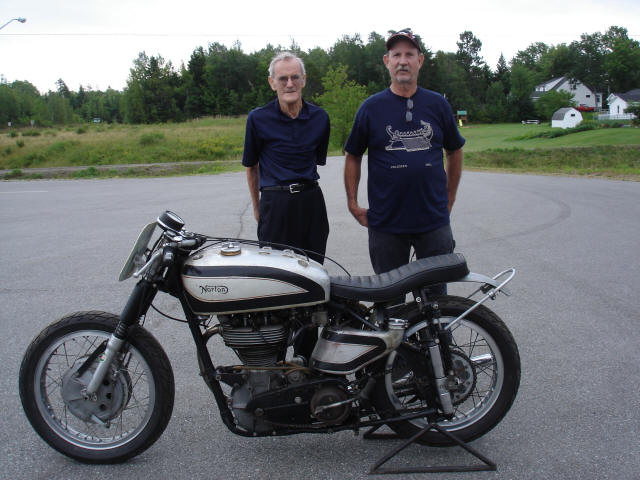
John Johnson was the Norton motorcycle distributor for the Maritimes. 
He not only sold bikes but he raced vintage motorcycles.

John Johnson (L) Gary Gates (R)  with a 1950 Norton Manx

Photo from Brit Cycles
In 1950, the bike pictured on the left was sent by Norton to Daytona to compete. In 1959, John Johnson used this machine and any Norton rider available to promote the races in the Maritimes.

In the early 1990's, the Norton Manx was brought out of the mothballs it had lived under for almost 20 years and Thane Gillies would race it while John maintained it.

a number of vintage races were won on this bike including the first of the reunion races at the original track for the Laconia Nationals held at Gunstock. In 2006 the Manx raced for the last time.  Gary Gates, pictured in the photo with John is the new owner of the Norton.
John Johnson was also well known in the Maritimes as a mechanic and machinist whose talents were heavily relied upon. His generous nature made him an appreciated sponsor of motorcycle racing and riders as well as a valued friend. Because of his passion, many a rider was introduced to the sport of motorcycling in the Maritimes!

I hope you enjoyed our short journey through the history of  motorcycling in the Maritimes.
Motorcycling has a storied history in Canada.  We have literally hundreds of racers and pioneers of the sport to thank for making motorcycling the enjoyable pastime it has become for so many.

While most of the historical facts and stories focus on the contribution of mechanics, engineers, machinists and racers, there truly is a more social aspect to the sport and that is touring and cruising.

Beginning back at the turn of the 19th century with bicycle clubs, the motorcycle became the natural benefactor of man's need to belong to a tribe and almost every club that was formed up into the 40's had a more social and less sporting side to it.  Road Riding was incorporated into pretty much every club that sprang up, but they all had their roots in racing.

In the 1940's the Red Devils opened up the first MC in Canada and our community would never be the same.

Join me next time as we explore the beginning of the One Percent culture in Canadian motorcycling.

Belt Drive Betty, Editor & Rider


Interesting Historical Tidbits:


1908 - "Anne of Green Gables" makes Lucy Maud Montgomery of Clifton, Prince Edward Island, Canada famous

1912 - Thomas Wilby and F.V. Haney make the first cross-Canada trip by car, travelling from        
            Halifax to Victoria in 52 days in a Canadian-built Reo

1923 - Drivers in Nova Scotia began driving on the right hand side of the road.

1927 - The first ever nationwide radio broadcast, was held to mark the 60th anniversary of      
            confederation, and could be heard as far away as South America and Britain.

1930 - Actor Gordon Pinset is born Grand Falls, Newfoundland and Labrador

1935 - Actor Donald Sutherland is born in Saint John New Brunswick

1944 - Rita MacNeil is born in Big Pond Nova Scotia

1949 - The Maritime Motor Maids started out as the Eastern Canada District. New Brunswick, Nova Scotia, Prince Edward Island and Newfoundland & Labrador.

1949 - Newfoundlan becomes Canada's 10th province.

1957 - Canada becomes the first country with a two screen theater.  Nat Taylor, owner of the Elgin Street theatre in Ottawa Ontario went on to invent the Cineplex or Multiplex style of theatres.

1964 - The Canadian Social Insurance Number comes into use.

1974 - Atlantic Motorsport Park opened.


Research for this article:
Canadian Motorsports Hall of Fame
Maritime motorsports Hall of Fame
The Chronicle Herald
Hemmings.com
Motorcycle Hall of Fame
Brit Cycle


Disclaimer:

All data and information provided on this site is for informational purposes only. The Belt Drive Betty Blog makes no representations as to accuracy, completeness, currentness, suitability, or validity of any information on this site & will not be liable for any errors, omissions, or delays in this information or any losses, injuries, or damages arising from its display or use. All information is provided on an as-is basis.

Wednesday, October 14, 2015

Motorcycling in Canada - A Ride through Our History Part 6

Motorcycling in Canada - A Ride through Our History Part 6

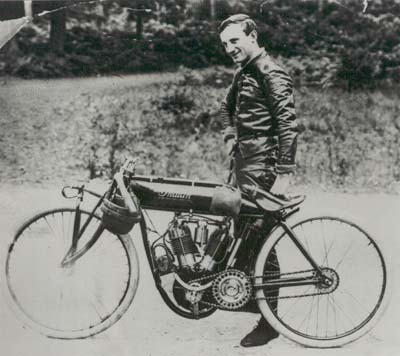
Borne in St. Ulric, QC on December 10th 1879, Jacob DeRosier would move to Massachusetts at the age of four and went on to be one of the winningest motorcycle racers in history.

The wiry DeRosier started his racing career riding bicycles. In 1898m he got the opportunity to ride on one of the new French pace bikes owned by Henri Fournier.

They were large-engined two-wheelers that were used for pacing bicycles in an effort to help the riders achieve faster speeds.  Fournier agreed to let DeRosier try one and he demonstrated so much skill that he was hired to ride the machines at bicycle races in Paris.

In 1901, Jake who was considered one of the top cycle pacers in the US, met the co owner of Indian Motorcycles, Oscar Hedstrom. He was offered a job and a motorcycle to race.

DeRosier worked for Indian for a short time, but ended up becoming a factory sponsored board track racer.

DeRosier had not only won the National Federation of Americas Motorcycles Championship in 1908, but held every FAM speed record there was to hold in 1911.

It is rumoured that his departure from riding Indian Motorcycles was as a result of George Hendee being disappointed in DeRosier's showing at the Isle of Man TT in early 1911.  As a result, Jake DeRosier ended up riding for Excelsior.

Excelsior's V-twin, pocket-valve motor was nearly unbeatable.  At Chicago's Riverview motordrome, in August of 1911 an Excelsior set a record for the mile, burning up the boards at an average speed of 88.9 mph.

By September, the former Indian rider was in the saddle and not only did he win the feature event at Riverview, he set an unofficial world record for the kilometer, at a speed of 94 mph. With DeRosier riding, Ignaz Schwinn's motorcycle company, Excelsior quickly became a serious race contender. Excelsior was being hailed as the fastest bike on the boards! DeRosier's tenure at Excelsior proved brief.
Jacob DeRosier's career, which saw him ride in over 900 races, came to an end on March 12, 1912, he suffered severe injuries to his left leg and thigh at Los Angeles.

Enduring three surgeries, as doctors attempted to repair the damage to his left leg, he succumbed to complications of the last operation on Feb. 25,1913.  Jacob DeRosier was laid to rest in Springfield Massachusetts, the home of Indian Motorcycles. As his funeral procession passed the factory, it was to the flags of the Indian Motorcycle Co., being flown at half mast and all production at the plant was ceased. DeRosier was 33 years old.

Quebec has had it's share of talented riders!


Suzuki, Honda, Yamaha and Kawasaki have many things in common.

They all got their start in Japan.  Of the four, Kawasaki was the late entry to Canadian manufacturing. Honda came to Canada in 1969, both Suzuki and Yamaha entered the market in 1973; Kawasaki did not arrive until 1982.

They all proved one thing, very quickly!

They could dominate on the racetracks of the world and one Canadian racer, Michel Mercier, rode all of them, winning many championships on each brand, covering 4 disciplines!
 
Michel Mercier - Pierre Nadeau, LA Tribune
Born in Thetford Mines Quebec in 1953, Michel, like many a young man began his racing career in motocross.  He won many a motocross championship and held the prestigious #1 Canadian National Ice Racing plate 5 times!

During his 18-year career as a rider, he road raced for 10 years, dirt tracked for 3 years, Ice raced for 7 years and motocross raced for 4 years and all of those years and races netted him:
25 Canadian National Titles
5 Canadian National #1 plates in Ice Racing
3 Canadian National #1 plates in Road Racing

People like Fred Deeley and Raymond Greff helped this great Canadian racer when he road dirt track. He was given a Harley-Davidson XR750 to ride in 1978 and he did not disappoint H-D either!

In fact this man, Michel Mercier was one of the first Bombardier team riders – in other words, he rode everything two wheels and did it like a champion!


Today Michel is the owner of Fast Riding School.  He teaches at Shannonville Motorsports Park.

No article on Quebec motorcycling would be complete without talking about the Gref family.
The Gref family is another of those families that has motorsports in their blood.

Charles Gref Sr. was born in 1912. His love affair with the motorcycle began in 1937 and by 1947 he was the Canadian Champion in the expert class of the Canadian Trials. He went on to be a director of the CMA and the president of the Montreal Motorcycle Club.

Raymond Gref - Moto Internationale
His son Raymond, a founding member and the first president of the Club Moto Saguenay spent over 50 years in the motorcycle industry. As a competitor whose racing career spanned 8 years, Raymond was only defeated once.

He went on to be a driving force in Quebec motorcycling. Not only did he found Moto International and Harley-Davidson of Montreal, but he was responsible for organizing many a race and could always be found promoting the sport.

Normand Gref, Raymond's brother won 153 trophies during his racing career. Today, Normand is the used motorcycle sales manager at Moto Internationale.

Like his grandfather before him, Charles Gref Jr., the president of Moto International and Harley-Davidson Montreal had the motorcycling bug, only it found Charles Jr. much earlier in life.

At the age of 13 he had already won a number of trophies. He won the Miller Trophy, which in trials riding is the top honour in Eastern Canada, in both 1976 and 1977. His first win of the Miller Trophy came exactly 26 years AFTER his grandfather had won it!

Charles Jr. excelled in motocross, enduro, acceleration competitions and snowmobiling and the experiences he gained from being a competitor has helped him continue the tradition of Moto Internationale and Harley-Davidson Montreal being consistently top dealerships in Canada.

Quebec has produced so many inspiring motorcyclists, Yvon Duhamel, Duc du Four, Marc St Laurent, Pierre Corbeil, Paul Noiseux and many, many others.  It is no wonder that Quebec has one of the highest concentration of riders in Canada.


I hope you enjoyed our little ride through Quebec's impressive history of motorcycling.

Next time we begin exploring Atlantic Canada!


Interesting Historical Tidbits:

1901 - The Montreal Canadians are founded

1912 - Louis Cyr, born in Saint-Cyprien-de-Napierville QC the world's strongest man dies of Bright's Disease (Kidney Disease)

1922 - The first prototype snow machine called the Snowdog was engineered by Joseph-Armand Bombardier

1928 - Women became recognized as legal "persons" by the Judicial Committee of the Privy Council

1929 - Montreal QC becomes home to the third oldest motorcycle club in Canadian history, The Sports Motor Cycle Club (SMCC).

1931 – Canada's first television station, VE9EC, begins broadcasting in Montréal

1936 – Air Canada founded on August 11 as Trans-Canada Airlines.

1940 - Quebec is the last province (of the time period) to grant the vote to women.

1940 - Canadian, Fred Moffatt of General Electric invents the electric tea kettle

1941 - Legislation is changed to allow women to enlist in the Canadian Forces.
           45,000 + women volunteer for full-time military service other than nursing. All three services              establish women's divisions. 

1941 - Elizabeth "Betty" MacRae, Canada's first female neurosurgeon is born as is activist and folk                singer Buffy Sainte-Marie.

1942 - Montreal celebrates it's 300th birthday

1942 - The Women's Royal Canadian Navel Service (WRENS) is established.

1942 - Genevieve Bujold, a Canadian actress best known for her portrayal of Anne Boleyn in the                    1969 film Anne of the Thousand Days is born in Montreal

1947 - General Electric invents the electric washing machine

1948 - Barbara Ann Scott becomes the first Canadian woman to win the World Figure Skating                         championships.


Research for this article
Canadian Motorcycle Hall of Fame
Charles Gref Jr.
1909, The Great Motorcycle Invasion by Mark Dill
American Motorcycle Hall of Fame
FirstSuperSpeedway.com
Findagrave.com
Indian Motorcycle Classics
Chronologie de l'histoire du Québec Canadian Encyclopedia - Women in the Military

Fastridingschool.com
LA Tribune


Disclaimer:


All data and information provided on this site is for informational purposes only. The Belt Drive Betty Blog makes no representations as to accuracy, completeness, currentness, suitability, or validity of any information on this site & will not be liable for any errors, omissions, or delays in this information or any losses, injuries, or damages arising from its display or use. All information is provided on an as-is basis.