Showing posts with label Yamaha. Show all posts

Wednesday, December 09, 2015

Motorcycling in Canada - A Ride Through our History - Part 10


While Honda was the first Japanese Motorcycle Manufacturer to open offices in Canada, the true invasion of the Japanese motorcycle into Canada didn't begin until 1973 when Yamaha, Suzuki and Kawasaki came to Canada.


The Yamaha Corporation in Japan began by producing reed organs in 1887 with the name of Nippon Gaki Corporation Ltd. 

The birth of the Yamaha Motor Company Ltd.,  is credited to Genichi Kawakami in 1953. Genichi was looking to make use of idle machining equipment that was previously being used for making aircraft propellers. While the company at that time was already doing well on the financial front, the first president of the Yamaha Motor Company was looking for the next area of business for Yamaha.

He looked into various products before the market and competitive forces led him to focus on the motorcycle market.  

Genichi visited the United States many times during the 50's. In his endeavor he had his research division chief and other managers visit various factories around the country of Japan. On their tour to Europe, Genichi and his team researched and learned how to make a motorcycle that would compete with the best there was in racetracks.  

The YA-1
The first Yamaha Motorcycle was produced in 1955, the YA-1, by 1958, they were distributing motorcycles through Cooper Motors in the US. The YD1 (250cc, 2-stroke, twin cylinder, streetbike) and MF-1 (50cc, 2-stroke, single cylinder, streetbike, step-through) were the models that entered the US market first.

By 1960 the Yamaha International Corp was founded and they began selling their motorcycles and setting up a dealer network.


The 70's were a time of huge expansion for Yamaha, they introduced the XS-1 (650cc vertical twin), their first four stroke machine, and in 1971 they introduced the SR433 high performance snowmobile.

1975 was a ground breaker year for Yamaha as they introduced the first factory produced mono shock bikes - bikes that forever changed the sport of motocross. The YZ Monocross machines.

The SRX440 snowmobile hit the market and quickly catapulted Yamaha to the forefront of the snowmobile racing scene in 1976.

Yamaha continued to expand their line of machines and in 1978 they introduce the XS1100 motorcycle (four cylinder, shaft drive) and the XS650 Special, the first production Cruiser built by a Japanese manufacturer.

The firsts for Yamaha kept piling up, and in 1981, their  first air-cooled, V-twin cruiser, the Virago 750, was introduced and the first production 5-valve per cylinder engine was introduced via the FZ750 motorcycle.

In the mid eighties, Yamaha introduced the V-Max 1200 muscle bike.

The later 80's Yamaha concentrated on increasing their presence in waterspouts by acquiring a number of boat makers and then in 1996, they introduced the first Star model, the 1300cc, V4 Royal Star.

In 1998 the first mass produced 4-stroke motocrosser, the YZ400F four-stroke motocross bike was introduced.
The YZF-R1 sport bike hit the track and set the standard for open class sport bikes for several years.

While a very diversified manufacturer, Yamaha proved itself on the race tracks of the world, not only in motocross but road racing as well.

In 1972, Canadian Ron Keys garnered both the 125 and 500 titles at the motocross races in Chicoutimi QC, beating out two-time 500 World Champion Jeff Smith, on a Yamaha YZ125!

Ross “Rollerball” Pederson of Medicine Hat Alberta took Yamaha to special heights during his motocross, supercross and arena cross career. He is considered to be the best motocross racer in Canada by many.

"Rollerball" dominated Canadian motocross, supercross, and arenacross for more than a dozen years. Between 1980 & 1993 he won an unprecedented 42 National Championships that included all eight of the Supercross Championships held in Canada.

In 1980 Pederson, who turned pro with Yamaha, took the 125, 250, and 500cc machines to three National Championship titles. Rollerball's domination wouldn’t end for 13 years. 

The racers who have taken Yamaha to some of its greatest heights in Moto GP were/are Valentino Rossi and team mate Jorge Lorenzo in the Moto GP.  between them they have racked up an impressive number of wins for Yamaha (Over 80).

Valentino Rossi, Fox Sports
As a corporation, Yamaha Canada has achieved some impressive heights. They are the first non American corporation to sign an agreement with the Cree's of Waskaganish QC. They were named one of the top 100 employees in Canada and were featured in Maclean's Magazine.

Yamaha's Riding Academy has taught thousands of young Canadians how to ride and instilled in them the desire to ride!

Next up we explore Suzuki and some of it's impressive history.


Belt Drive Betty
Editor & Rider

Research for this article:

Legends of Canadian Motocross
Motopark Racing
Motocross Archives
Valentino Rossi
Yamaha
www.waskaganish.ca
Fox Sports
CVMG


Disclaimer:


All data and information provided on this site is for informational purposes only. The Belt Drive Betty Blog makes no representations as to accuracy, completeness, currentness, suitability, or validity of any information on this site & will not be liable for any errors, omissions, or delays in this information or any losses, injuries, or damages arising from its display or use. All information is provided on an as-is basis.

Wednesday, October 14, 2015

Motorcycling in Canada - A Ride through Our History Part 6

Motorcycling in Canada - A Ride through Our History Part 6

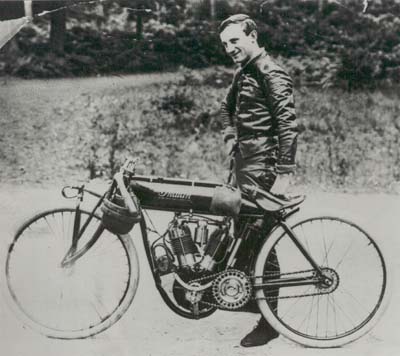
Borne in St. Ulric, QC on December 10th 1879, Jacob DeRosier would move to Massachusetts at the age of four and went on to be one of the winningest motorcycle racers in history.

The wiry DeRosier started his racing career riding bicycles. In 1898m he got the opportunity to ride on one of the new French pace bikes owned by Henri Fournier.

They were large-engined two-wheelers that were used for pacing bicycles in an effort to help the riders achieve faster speeds.  Fournier agreed to let DeRosier try one and he demonstrated so much skill that he was hired to ride the machines at bicycle races in Paris.

In 1901, Jake who was considered one of the top cycle pacers in the US, met the co owner of Indian Motorcycles, Oscar Hedstrom. He was offered a job and a motorcycle to race.

DeRosier worked for Indian for a short time, but ended up becoming a factory sponsored board track racer.

DeRosier had not only won the National Federation of Americas Motorcycles Championship in 1908, but held every FAM speed record there was to hold in 1911.

It is rumoured that his departure from riding Indian Motorcycles was as a result of George Hendee being disappointed in DeRosier's showing at the Isle of Man TT in early 1911.  As a result, Jake DeRosier ended up riding for Excelsior.

Excelsior's V-twin, pocket-valve motor was nearly unbeatable.  At Chicago's Riverview motordrome, in August of 1911 an Excelsior set a record for the mile, burning up the boards at an average speed of 88.9 mph.

By September, the former Indian rider was in the saddle and not only did he win the feature event at Riverview, he set an unofficial world record for the kilometer, at a speed of 94 mph. With DeRosier riding, Ignaz Schwinn's motorcycle company, Excelsior quickly became a serious race contender. Excelsior was being hailed as the fastest bike on the boards! DeRosier's tenure at Excelsior proved brief.
Jacob DeRosier's career, which saw him ride in over 900 races, came to an end on March 12, 1912, he suffered severe injuries to his left leg and thigh at Los Angeles.

Enduring three surgeries, as doctors attempted to repair the damage to his left leg, he succumbed to complications of the last operation on Feb. 25,1913.  Jacob DeRosier was laid to rest in Springfield Massachusetts, the home of Indian Motorcycles. As his funeral procession passed the factory, it was to the flags of the Indian Motorcycle Co., being flown at half mast and all production at the plant was ceased. DeRosier was 33 years old.

Quebec has had it's share of talented riders!


Suzuki, Honda, Yamaha and Kawasaki have many things in common.

They all got their start in Japan.  Of the four, Kawasaki was the late entry to Canadian manufacturing. Honda came to Canada in 1969, both Suzuki and Yamaha entered the market in 1973; Kawasaki did not arrive until 1982.

They all proved one thing, very quickly!

They could dominate on the racetracks of the world and one Canadian racer, Michel Mercier, rode all of them, winning many championships on each brand, covering 4 disciplines!
 
Michel Mercier - Pierre Nadeau, LA Tribune
Born in Thetford Mines Quebec in 1953, Michel, like many a young man began his racing career in motocross.  He won many a motocross championship and held the prestigious #1 Canadian National Ice Racing plate 5 times!

During his 18-year career as a rider, he road raced for 10 years, dirt tracked for 3 years, Ice raced for 7 years and motocross raced for 4 years and all of those years and races netted him:
25 Canadian National Titles
5 Canadian National #1 plates in Ice Racing
3 Canadian National #1 plates in Road Racing

People like Fred Deeley and Raymond Greff helped this great Canadian racer when he road dirt track. He was given a Harley-Davidson XR750 to ride in 1978 and he did not disappoint H-D either!

In fact this man, Michel Mercier was one of the first Bombardier team riders – in other words, he rode everything two wheels and did it like a champion!


Today Michel is the owner of Fast Riding School.  He teaches at Shannonville Motorsports Park.

No article on Quebec motorcycling would be complete without talking about the Gref family.
The Gref family is another of those families that has motorsports in their blood.

Charles Gref Sr. was born in 1912. His love affair with the motorcycle began in 1937 and by 1947 he was the Canadian Champion in the expert class of the Canadian Trials. He went on to be a director of the CMA and the president of the Montreal Motorcycle Club.

Raymond Gref - Moto Internationale
His son Raymond, a founding member and the first president of the Club Moto Saguenay spent over 50 years in the motorcycle industry. As a competitor whose racing career spanned 8 years, Raymond was only defeated once.

He went on to be a driving force in Quebec motorcycling. Not only did he found Moto International and Harley-Davidson of Montreal, but he was responsible for organizing many a race and could always be found promoting the sport.

Normand Gref, Raymond's brother won 153 trophies during his racing career. Today, Normand is the used motorcycle sales manager at Moto Internationale.

Like his grandfather before him, Charles Gref Jr., the president of Moto International and Harley-Davidson Montreal had the motorcycling bug, only it found Charles Jr. much earlier in life.

At the age of 13 he had already won a number of trophies. He won the Miller Trophy, which in trials riding is the top honour in Eastern Canada, in both 1976 and 1977. His first win of the Miller Trophy came exactly 26 years AFTER his grandfather had won it!

Charles Jr. excelled in motocross, enduro, acceleration competitions and snowmobiling and the experiences he gained from being a competitor has helped him continue the tradition of Moto Internationale and Harley-Davidson Montreal being consistently top dealerships in Canada.

Quebec has produced so many inspiring motorcyclists, Yvon Duhamel, Duc du Four, Marc St Laurent, Pierre Corbeil, Paul Noiseux and many, many others.  It is no wonder that Quebec has one of the highest concentration of riders in Canada.


I hope you enjoyed our little ride through Quebec's impressive history of motorcycling.

Next time we begin exploring Atlantic Canada!


Interesting Historical Tidbits:

1901 - The Montreal Canadians are founded

1912 - Louis Cyr, born in Saint-Cyprien-de-Napierville QC the world's strongest man dies of Bright's Disease (Kidney Disease)

1922 - The first prototype snow machine called the Snowdog was engineered by Joseph-Armand Bombardier

1928 - Women became recognized as legal "persons" by the Judicial Committee of the Privy Council

1929 - Montreal QC becomes home to the third oldest motorcycle club in Canadian history, The Sports Motor Cycle Club (SMCC).

1931 – Canada's first television station, VE9EC, begins broadcasting in Montréal

1936 – Air Canada founded on August 11 as Trans-Canada Airlines.

1940 - Quebec is the last province (of the time period) to grant the vote to women.

1940 - Canadian, Fred Moffatt of General Electric invents the electric tea kettle

1941 - Legislation is changed to allow women to enlist in the Canadian Forces.
           45,000 + women volunteer for full-time military service other than nursing. All three services              establish women's divisions. 

1941 - Elizabeth "Betty" MacRae, Canada's first female neurosurgeon is born as is activist and folk                singer Buffy Sainte-Marie.

1942 - Montreal celebrates it's 300th birthday

1942 - The Women's Royal Canadian Navel Service (WRENS) is established.

1942 - Genevieve Bujold, a Canadian actress best known for her portrayal of Anne Boleyn in the                    1969 film Anne of the Thousand Days is born in Montreal

1947 - General Electric invents the electric washing machine

1948 - Barbara Ann Scott becomes the first Canadian woman to win the World Figure Skating                         championships.


Research for this article
Canadian Motorcycle Hall of Fame
Charles Gref Jr.
1909, The Great Motorcycle Invasion by Mark Dill
American Motorcycle Hall of Fame
FirstSuperSpeedway.com
Findagrave.com
Indian Motorcycle Classics
Chronologie de l'histoire du Québec Canadian Encyclopedia - Women in the Military

Fastridingschool.com
LA Tribune


Disclaimer:


All data and information provided on this site is for informational purposes only. The Belt Drive Betty Blog makes no representations as to accuracy, completeness, currentness, suitability, or validity of any information on this site & will not be liable for any errors, omissions, or delays in this information or any losses, injuries, or damages arising from its display or use. All information is provided on an as-is basis.