Showing posts with label Canadian Motorcycle History. Show all posts

Wednesday, December 09, 2015

Motorcycling in Canada - A Ride Through our History - Part 10


While Honda was the first Japanese Motorcycle Manufacturer to open offices in Canada, the true invasion of the Japanese motorcycle into Canada didn't begin until 1973 when Yamaha, Suzuki and Kawasaki came to Canada.


The Yamaha Corporation in Japan began by producing reed organs in 1887 with the name of Nippon Gaki Corporation Ltd. 

The birth of the Yamaha Motor Company Ltd.,  is credited to Genichi Kawakami in 1953. Genichi was looking to make use of idle machining equipment that was previously being used for making aircraft propellers. While the company at that time was already doing well on the financial front, the first president of the Yamaha Motor Company was looking for the next area of business for Yamaha.

He looked into various products before the market and competitive forces led him to focus on the motorcycle market.  

Genichi visited the United States many times during the 50's. In his endeavor he had his research division chief and other managers visit various factories around the country of Japan. On their tour to Europe, Genichi and his team researched and learned how to make a motorcycle that would compete with the best there was in racetracks.  

The YA-1
The first Yamaha Motorcycle was produced in 1955, the YA-1, by 1958, they were distributing motorcycles through Cooper Motors in the US. The YD1 (250cc, 2-stroke, twin cylinder, streetbike) and MF-1 (50cc, 2-stroke, single cylinder, streetbike, step-through) were the models that entered the US market first.

By 1960 the Yamaha International Corp was founded and they began selling their motorcycles and setting up a dealer network.


The 70's were a time of huge expansion for Yamaha, they introduced the XS-1 (650cc vertical twin), their first four stroke machine, and in 1971 they introduced the SR433 high performance snowmobile.

1975 was a ground breaker year for Yamaha as they introduced the first factory produced mono shock bikes - bikes that forever changed the sport of motocross. The YZ Monocross machines.

The SRX440 snowmobile hit the market and quickly catapulted Yamaha to the forefront of the snowmobile racing scene in 1976.

Yamaha continued to expand their line of machines and in 1978 they introduce the XS1100 motorcycle (four cylinder, shaft drive) and the XS650 Special, the first production Cruiser built by a Japanese manufacturer.

The firsts for Yamaha kept piling up, and in 1981, their  first air-cooled, V-twin cruiser, the Virago 750, was introduced and the first production 5-valve per cylinder engine was introduced via the FZ750 motorcycle.

In the mid eighties, Yamaha introduced the V-Max 1200 muscle bike.

The later 80's Yamaha concentrated on increasing their presence in waterspouts by acquiring a number of boat makers and then in 1996, they introduced the first Star model, the 1300cc, V4 Royal Star.

In 1998 the first mass produced 4-stroke motocrosser, the YZ400F four-stroke motocross bike was introduced.
The YZF-R1 sport bike hit the track and set the standard for open class sport bikes for several years.

While a very diversified manufacturer, Yamaha proved itself on the race tracks of the world, not only in motocross but road racing as well.

In 1972, Canadian Ron Keys garnered both the 125 and 500 titles at the motocross races in Chicoutimi QC, beating out two-time 500 World Champion Jeff Smith, on a Yamaha YZ125!

Ross “Rollerball” Pederson of Medicine Hat Alberta took Yamaha to special heights during his motocross, supercross and arena cross career. He is considered to be the best motocross racer in Canada by many.

"Rollerball" dominated Canadian motocross, supercross, and arenacross for more than a dozen years. Between 1980 & 1993 he won an unprecedented 42 National Championships that included all eight of the Supercross Championships held in Canada.

In 1980 Pederson, who turned pro with Yamaha, took the 125, 250, and 500cc machines to three National Championship titles. Rollerball's domination wouldn’t end for 13 years. 

The racers who have taken Yamaha to some of its greatest heights in Moto GP were/are Valentino Rossi and team mate Jorge Lorenzo in the Moto GP.  between them they have racked up an impressive number of wins for Yamaha (Over 80).

Valentino Rossi, Fox Sports
As a corporation, Yamaha Canada has achieved some impressive heights. They are the first non American corporation to sign an agreement with the Cree's of Waskaganish QC. They were named one of the top 100 employees in Canada and were featured in Maclean's Magazine.

Yamaha's Riding Academy has taught thousands of young Canadians how to ride and instilled in them the desire to ride!

Next up we explore Suzuki and some of it's impressive history.


Belt Drive Betty
Editor & Rider

Research for this article:

Legends of Canadian Motocross
Motopark Racing
Motocross Archives
Valentino Rossi
Yamaha
www.waskaganish.ca
Fox Sports
CVMG


Disclaimer:


All data and information provided on this site is for informational purposes only. The Belt Drive Betty Blog makes no representations as to accuracy, completeness, currentness, suitability, or validity of any information on this site & will not be liable for any errors, omissions, or delays in this information or any losses, injuries, or damages arising from its display or use. All information is provided on an as-is basis.

Wednesday, November 04, 2015

Motorcycling in Canada - A Ride Through our History - Part 9

Honda in Canada

The Honda Motor Corporation Ltd. based in Japan, was founded in 1946 by Soichiro Honda.

In the field of motorcycle manufacturing, it is the largest public multinational corporation in the world. Since 1959 it has held the top position in the manufacturing of motorcycles and internal combustion engines.

In 1946, Japan was trying to rebuild from the effects of the Second World War.

Honda, a talented mechanic began manufacturing piston rings before turning his attention to motorcycles. He had realized that there was a need for an affordable means of transportation and began grafting war surplus two stroke motors into bicycles. The initial shaky start due to his lack of training in metallurgy in the production of piston rings gave way to his passion for engineering.

The first motorcycle that featured a completely Honda designed motor and frame was produced in 1949. By the 1960’s his motorcycles were up against the best on the racetracks of the world.   

Figure 1 - Honda's 1st Prototype

Figure 2 - Honda's First Motorcycle, 1949, Model D

Honda ventured into the Canadian history books in 1969. With hard work and perseverance they slowly gained the trust of Canadians. Over a period of time Honda gained respect in the marketplace as well. In 1986, Honda built a car manufacturing facility in Alliston, Ontario. In 1998 a second plant was built at the same site and in 2008 Honda completed its third manufacturing facility. On May 2010, Honda Canada moved to their new Gold Certified Leed (Leadership in Energy and Environmental Design) Head Office in Markham, Ontario which is now home to approximately 600 associates. Today Honda employs almost 19,000 Canadians and buys goods worth 1.1 billion from Canadian suppliers!


Honda has turned its vision towards providing a sustainable growth for the future. Blue Skies for Our Children embodies the vision of keeping the environment in mind for the future generations so that they might find the joy of free mobility along with sustained development. The challenge of sustained development encompasses numerous energy and environmental issues. The most important amongst them has been the reduction of greenhouse gases that lead to global warming. In June 2011, Honda pledged to reduce CO2 emissions from automobiles, motorcycles and corporate activities by 30% by 2020. There have been significant advances towards achieving this end. These technologies include natural gas vehicles, hybrids, fuel cell electric along with new energy creation and distribution technologies like Honda’s original solar cell.

A socially responsible and engaged corporation, Honda Canada started the Honda Canada Foundation to enhance the social well being of Canadians. The focus of the foundation is to provide grants in the areas of education, engineering, the environment and safety with a focus on youth.

Even back in the beginning of its emergence in the UA and Canadian cultures, Honda showed its social responsibility in other ways. They had a rider’s manual that explained the operation of their motorcycle and asked people to be socially respectful.

Image 3 - 1962 Honda Owners Manual

One of the most successful marketing campaigns in history started in the US. Honda had suffered a number of recalls, and the owner of the first Honda store in California, Kihachiro Kawashima, had to take back every bike he had sold. He had a bunch of 50cc scooters in the back of the shop and decided to get them out on the sales floor. 

His ad campaign “You meet the nicest people on a Honda” saved the American market and paved the way for the Canadian market to have a successful launch. 
Image 4 - Honda's Ad campaign in the 60's
Although Honda has a varied stable of machines, the CBR and the Goldwing, two very different machines, are probably the best known of all of Honda's motorcycles.

The CBR is dubbed by Honda as the ultimate handling machine and many a CBR rider will tell you that is so, however GSXR riders will tell you something quite different!

Today, Honda Canada plays a big roll in all manners of racing and their motorcycles are well respected for their reliability, their socially responsible exhaust systems, their power and fuel economy.

I hope you enjoyed the brief look into Honda Canada, next up we look at Kawasaki, Yamaha and Suzuki!
 

Research for this article:
Wikipedia
Honda Canada
Honda Canada Foundation
Petrolicious Productions

Images:


image 2- a 1949 Model D (Dream)

Image 3 - 1962 Honda Owners Manual

http://www.petrolicious.com - Image 4


Disclaimer:


All data and information provided on this site is for informational purposes only. The Belt Drive Betty Blog makes no representations as to accuracy, completeness, currentness, suitability, or validity of any information on this site & will not be liable for any errors, omissions, or delays in this information or any losses, injuries, or damages arising from its display or use. All information is provided on an as-is basis.


Monday, July 06, 2015

Motorcycling in Canada - A Ride Through Our History - Part 2

Motorcycling in Canada - A Ride Through Our History - Part 2

In the 1890's bicycles were the most affordable and popular form of transportation and bicycle clubs had sprung up all over. Many a bicycle club eventually evolved into motorcycle clubs.

The bicycle itself is largely responsible for the emancipation of women. Not only did women find a new found freedom with regards to transportation but there was a sense of self reliance that the bicycle offered. Because of the dress of the day; voluminous skirts and dresses, the bicycle is also somewhat responsible for the fashion revolution of bloomers - the precursor to women's pants.


A motorcycle was considered to be an appropriate and acceptable form of transportation for women. 


You see, it was expected that, because women had taken so avidly to riding bicycles, that they would naturally gravitate towards motorcycles. In fact, in the book "Harley-Davidson - A History of the World's Most Famous Motorcycle" by Margie Siegal, there is a passage wherein the author discusses women's dress and what measures manufacturers took to ensure that women's skirts did not get caught up in the motor or final drive.


It appears that it wasn't until after World War II, that riding a motorcycle somehow became frowned upon for women, at least in some circles.


Motorcyclists played key roles in World War I & II

The Canadian Signal Corps was using Indian Motorcycles in 1917.


A group of despatch riders of the Canadian Signal Corps on Hendee motorcycles (Indian Powerplus) , Camp Valcartier, Quebec, ca 1917.  (Library and Archives Canada Photo, MIKAN No. 3336987) 


Motorcycles were used not just for communications in the military, but also for transporting ammunition, medications and extracting the wounded and the dead from the battlefield  and taking them to medical facilities.


Many women rode "despatch" during both World Wars, albeit rarely on the front lines.


The British Wrens

Outside of the roles the motorcycle played in competitive sports and military use, this economical means of transportation became a transportation staple in many regions in Canada.

The motorcycle could take you where cars, early trucks and often horse and wagon couldn't. 
It could haul things and it sprouted all kinds of small empires.
It was affordable and had a very long range for fuel, which was important as filling stations were few and far between in rural Canada.


And back in the day, the fuel range could be made very long!

In fact, American racing legend, Smokin Joe Petrali was 14 years old in 1918 when he got 176 miles to a gallon of fuel by riding his bike at an idle and won the national economy class for 30.50-cubic-inch motorcycles in the US. 

His bike? A 1914 30.50-inch (500cc) Indian Standard that cost him $35.00

I discussed in my previous article, some of the contributions to motorcycling that the Deeley family brought to British Columbia and Canada in 1914 and on into modern times, but BC was not the only place in Canada where enterprising men were impacting the Canadian motorcycling scene.

Far from it. 

All across the country there were people who impacted our community, sport, industry and country.

Let's move on to Alberta in the early 1930's...where the motorcycle, anger and determination to do the right thing started an empire.

In 1931 a very angry young Walt Healy became the Indian dealer in Calgary Alberta.

Why was 18 year old Walt so angry?


Walt Healy: www.walthealy.com
Well you see this enterprising young man had started running a delivery service at 13 years of age. 

He started first with bicycles and once he earned enough money he purchased a 1914 Douglas for $15. 

That Douglas allowed him to earn money faster and soon he owned both a Harley and and Indian side car outfit. 

So the story goes, Walt had gone to then Harley-Davidson dealer Clyde Paul and put a deposit down on the next Harley Police bike to come in. 

When he went in to collect the motorcycle he was told by the dealer, that he had sold it to someone else.  Well, young Walt said, "I want the next police rig that comes in", and again the story repeated itself. This time Clyde, had decided he was going to make the rig into a hill climber instead of selling it to young Walt. To Walt's way of thinking, this was a poor way to do business.

Walt ended up buying a 101 Indian Scout engine from Clyde for the $20 he had on deposit, and then he bought an Indian from a friend for $10. He built that motorcycle to be a hill eating, Harley eating, Clyde's pride eating machine and made sure to enter every race that Clyde did.  

Reportedly Clyde never did beat Walt.

In the meantime, Walt had gone to the Indian Dealer to buy two bikes and ended up buying the Calgary Indian dealership for $100 thanks to a friend who co-signed the note.

Between his dealership and delivery service Walt managed to eek out a living, eventually hiring his dad to wrench on bikes. The hard work and long hours paid off. Over the years Walt Healy's not only became a dealership to be reckoned with but the man himself was a force to be reckoned with.  

He was behind the motorcycle mechanics trade being officially recognized by the Alberta government.

It took him 18 years and he saw four ministers of transport go through their terms as he sought to have motorcycle mechanics recognized as a licensed trade in Alberta. 

In 1986, he received his own motorcycle mechanics licence.

As a young man of 14, Walt had subsidize his income from the delivery service by allowing other young people to ride his motorcycle.  He'd charge them 5 cents, teach them the basics and let them ride his motorcycle up and down the block but if they turned the corner and went out of sight, he'd charge them 10 cents.  

We'll that desire to teach others to ride culminated in his ‘Learn to Ride’ program.

Eventually the program turned into the Calgary Safety Council, and that evolved into what is now known as the Canada Safety Council.

Walt Healy passed away in 2002 and sadly on March 31, 2014 Walt Healy Motorsports closed for good, closing a chapter on Alberta and Canadian motorcycling history.

Walt Healy's contributions to motorcycling are many and whether you have ever heard his name or not, his influence, determination, work ethic, persistence, passion and knowledge of the motorcycle forever changed the face of motorcycling in Canada.


Interesting historical tidbits:

1911: The Toronto Police Service, Canada's first police service was also the first police service to put motorcycles into use.

1920: British Columbia became the third province to start driving on the right hand side of the road.
Ontario and Quebec were the first provinces to adopt this practise. New Brunswick, Nova Scotia and PEI followed suit shortly thereafter.

1926: The Calgary Motorcycle Club was founded by Walt Healy in 1926, and still exists today.

1937:  The first intercity, divided highway in North America opens featuring the longest stretch of consistently illuminated road in the world at that time. The Queen Elizabeth Way, named after the Queen Mum, is 139.1 kilometres in length.

1940: The Red Devils MC is founded in Hamilton Ontario

1949: Parliament passes the Trans Canada Highway Act to build a highway that would connect all of Canada, the act ensured cost sharing between federal and provincial governments. Today the Trans Canada highway is 8,030 KM's long, construction started in 1950 and the highway officially opened in 1962 and was completed in 1971 making it one of the longest national highways in the world.

1949: The Motor Maids of the Eastern Canadian District was founded, in 2007 their district became known as the Atlantic Canada District.

1949: Olds Motorcycle Sales opened on a farm near Olds AB, today we know the dealership as Turple Brothers located in Red Deer.

I hope you enjoyed this little ride down memory lane!

There is more in store for you as next time we look at Saskatchewan and it's involvement in the early days of motorcycling.


I hope you will join us in our quest to find Canada's MOST Rider Friendly Community.
It is a truly a contest of exploration, discovery and community pride. 12 communities will share in over $60,000 in marketing! 


Visit www.riderfriendlycontest.ca to find out more and start thinking of the Canadian community that you think is worthy of the title, Canada's MOST Rider Friendly Community.

If you are blessed enough to be riding today, please remember to ride like everyone around you is blind and cannot see you!

Belt Drive Betty,
Editor & Rider


Research for this article:

Greg Williams:
(http://www.gregwilliams.ca/?page_id=75 & http://www.gregwilliams.ca/?page_id=193)
"Harley-Davidson - A History of the World's Most Famous Motorcycle" by Margie Siegal
Library and Archives Canada (http://www.bac-lac.gc.ca/eng/discover/military-heritage/Pages/military-heritage.aspx)
AMA Motorcycle Hall of Fame
In Search of the Canadian Car
Ontario Ministry of Transportation and Communications, Historical Committee
Bytes Daily


Disclaimer:
All data and information provided on this site is for informational purposes only. The Belt Drive Betty Blog makes no representations as to accuracy, completeness, currentness, suitability, or validity of any information on this site & will not be liable for any errors, omissions, or delays in this information or any losses, injuries, or damages arising from its display or use. All information is provided on an as-is basis.

Wednesday, June 24, 2015

Motorcycling in Canada, A Ride Through Our History - Part 1

1895 Roper Steam Velocipede - thevintagent.blogspot.ca

Throughout the centuries, man has endeavoured to expand his world through the use of machines.

Man’s ever-innovative and inquisitive mind, coupled with his need to find new thrills and adventure, means the development of the motorcycle was inevitable. The early years of motorcycling are fascinating as they offer up some of man’s most bizarre experimental machinery!

Sylvester Howard Roper built the first motorcycle in 1868. It was powered by a steam engine, and was demonstrated at fairs and circuses.

Many modern motorcycle features, including the twist handgrip throttle control,  evolved from the innovations on this machine.

By the late 1880s, motorcycle development became influenced by the internal combustion engine that had arrived on the scene.


Hildebrand & Woflmuller developed the first production motorcycle in 1894, and theirs was the first vehicle of its type to use the term “motorcycle”.

Hildebrand & Woflmuller
Deeley Motorcycle Exhibition


Hildebrand & Woflmuller
Deeley Motorcycle Exhibition

In 1901, Royal Enfield revealed its first motorcycle; it came with a 239 cc front-mounted engine and a belt drove the back wheel.

From 1901 on, the burgeoning sport of motorcycle racing fueled innovations at a fast and furious pace and as a result, hundreds of motorcycle companies sprang up around the world.

Even Canadians got into the act of producing motorcycles.

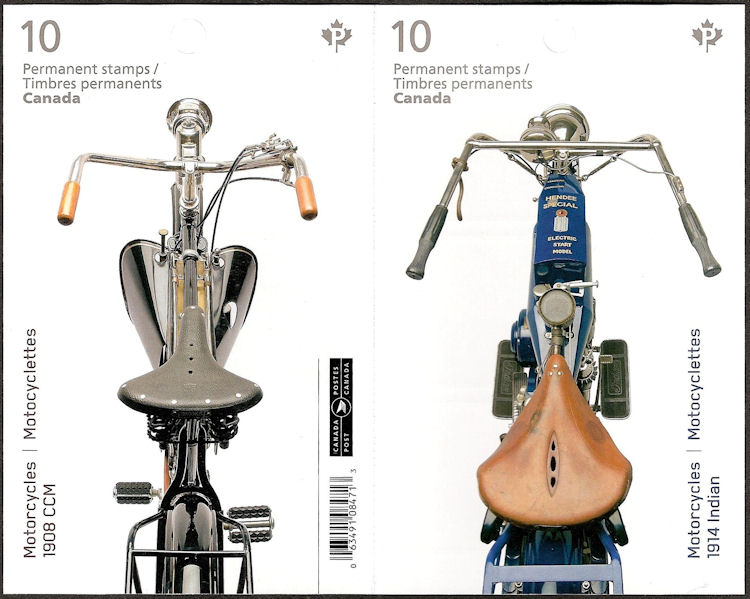
The CCM (Canadian Cycle & Motor Company) produced the Lightweight Motor Cycle from 1908 to 1911, there are only three known left to be in existence and one of them is at the Deeley Motorcycle Exhibition in Vancouver.

Canada Post

In 1912, Toronto's Mercer Street was home to the Hendee Mfg. Co production plant. (In 1928, Hendee Mfg. Co. became known as Indian)

During the First World War, motorcycles began to replace horses on the battlefield. Dispatch riders carried communications pouches and performed reconnaissance missions.

Triumph Motorcycles provided the allies with over 30,000 of its newly created Type-H bikes in World War I. Dubbed by many as the first “modern” motorcycle, the Model H by Triumph was the first motorcycle to be produced without pedals.


1922 Triumph Model H Yesterdays Antique Motorcycles

By 1920, Harley-Davidson had become the largest manufacturer of motorcycles with dealers in 67 countries, although it lost that spot for a number of years to German owned DKW in early 1930.

After World War II, as part of the reparations for the war, Harley-Davidson in the US, BSA in the UK and MMZ in Soviet Union were given the plans for the DKW RT125.

In the US the motorcycle became known as the Hummer, in the UK as the BSA Bantam and in Soviet Union as the M-1A Moskva.

Although many manufacturers in the US had sprung up to build and sell motorcycles, by 1931, only Harley-Davidson and Indian were still standing.

From 1931 until Indian closed its factory in Springfield Mass., and Royal Enfield took over the name in 1953, Harley-Davidson and Indian were fierce competitors.

From: harleyhummer.com
Here is a short list of some of the oldest American motorcycle marques:

  • Indian (1901-1953)
  • Pierce Arrow (1901-1913)
  • Curtiss (1902–1910)
  • Harley –Davidson (1903-present day)
  • Excelsior (1907-1931)
  • Iver Johnson (1907-1916)
  • Henderson (1911-1931)
  • Ace (1920-27)
  • Crocker (1936-1941)

The early 1900’s were an exciting time for the fledgling motorcycle community in Canada and Harley-Davidson Motorcycles played a huge role in that excitement and the growth of motorcycling as a sport and a pass time.

In 1907, Vancouver BC became home to the very first gas station in Canada; it was an Imperial Oil station. This would prove to play a significant role in the growth of motorcycling in Canada, and BC in particular, as the lower mainland of BC and Vancouver Island became hot beds for the sport.
  • In 1912, the Victoria Motorcycle Club became one of the first motorcycle clubs in Canada.
  • In 1913, Fred Deeley Sr. moved to Vancouver from Bromgsgrove England. In 1914 he opened a bicycle shop. He began importing BSA (Birmingham Small Arms Co) motorcycles.
  • In 1917 he began importing the Harley-Davidson motorcycle. It was around 1922 when the bicycle and motorcycle portions of the Deeley business became separate entities.
  • Fred Deeley Jr. founded the Lions Gate Motorcycle Club in 1922 and took over operations of the motorcycle division of Fred Deeley Motorcycles in 1925. Today the Lion’s Gate Motorcycle Club is known as the Greater Vancouver Motorcycle Club.
  • In 1935, 15-year-old Trev Deeley joins his father’s business as an apprentice mechanic.
  • In 1953, he takes over the business. Today, Trev Deeley Motorcycles is the fourth oldest Harley-Davidson dealer in the world.
Without a doubt, motorcycling in Canada would not have evolved into what it has today if it had not been for the Deeley’s, Fred Sr., Fred Jr. and Trev.

Some historical tidbits on the expansion of motorcycling in Canada:
  • 1919, the first retail dealership in Alberta opens up in Edmonton
  • 1936, Prairie Harley-Davidson opened up in Regina Saskatchewan under the helm of Grant Budd.
  • 1945, London Ontario becomes home to a Harley-Davidson dealership thanks to Percy Poole.
  • 1949 Laurent B. Groulx opened Pont-Viau Motorcyclettes in Ville de Laval, Quebec, Quebec’s first Harley-Davidson dealership.
  • 1969 was a year that would change many things in the Canadian Motorcycle Community. It was the year that Honda Motorcycles officially entered the Canadian market!
  • 1973, both Yamaha Motors Canada and Suzuki Canada are founded.
  • 1973 is also the year that Deeley Harley-Davidson became the official importer and distributor of Harley-Davidson motorcycles in Canada
I hope you enjoyed this little history lesson.


I also hope you will join us as we begin the quest to find Canada's MOST Rider Friendly Community.
Community Futures of Alberta, 
Belt Drive Betty Media, EastLink TV and a whole host of motorcycle media sponsors have gotten together to create over $60,000 in marketing packages to be shared by 12 communities!

The Grand Prize is a $35,000 marketing campaign!

It truly will be a contest of Exploration, Discovery & Community Pride! 


Belt Drive Betty
Editor & Rider


Resources for this article:
The Vintagent
Wikipedia
Wilson, Hugo (1995). The Encyclopedia of the Motorcycle. Dorling-Kindersley
Deeley Harley-Davidson Canada
Hope 1842 dot Com
Harley Hummer dot Com
Honda Canada
Yamaha Canada
Suzuki Canada
Ian Chadwick dot Com
Canadian Motorcycle Hall of Fame
Allan Johnson, CVMG
Terry Rea, Motorcycle Historian


Disclaimer:
All data and information provided on this site is for informational purposes only. The Belt Drive Betty Blog makes no representations as to accuracy, completeness, currentness, suitability, or validity of any information on this site & will not be liable for any errors, omissions, or delays in this information or any losses, injuries, or damages arising from its display or use. All information is provided on an as-is basis.