Monday, July 13, 2015

Motorcycling in Canada - A Ride Through Our History - Part 3

Motorcycling in Canada - A Ride Through Our History - Part 3

The dirty thirties were harder in rural Western Canada than anywhere else in the world, but out of the dust bowl of the prairies sprung up one of western Canada's most influential businesses and riders.

Nicholson Brothers Motorcycles was opened in Saskatoon Saskatchewan in 1933 by two brothers, Lawrence and J.B (Bernie) Nicholson.

While their dealership and mail order business was important to the growth of motorcycling in western Canada, J.B. (Bernie) Nicholson himself, is a man who influenced the motorcycle industry in a mighty way.
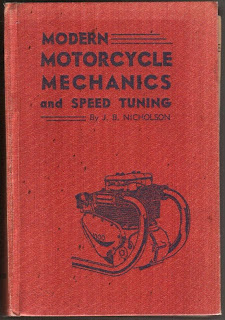
Photo located:
thevintagent.blogspot.ca
The Nicholson Brothers started out importing the Douglas and Calthorpe motorcycles and by 1935 had evolved their business into a mail order parts house replete with extensive catalogues of parts that were updated yearly and included information on all of the improvements each manufacturer had made to their motorcycle offerings.

Over the years they imported and sold motorcycles and parts for these brands (and others): 
Calthorpe, Douglas,  Raleigh, Rudge,  Scott, Panther, Super Excelsior, A.J.S., Ariel, Matchless, Norton, Royal Enfield, Panther, Sunbeam, Triumph, Villiers and Indian.

At the age of 25, Bernie constructed the first ever repair manual that offered diagrams and information on repairing and maintaining the motorcycles that he had worked on.

He had already been contributing technical articles to Motor Cycling magazine, but was inspired by the compliment paid to him by Graham Walker, the editor of Motor Cycling over the aide he had given writing and reworking an Indian manual.


According to the article written by Greg Williams:
"In a letter from Graham to Bernie dated October 31, 1941, Graham writes, “It is difficult to express in words just how much I appreciate the trouble you have gone to. You possess the happy knack of describing the necessary work in such a concise manner and in such a logical sequence as to make it understandable to even inexperienced fitters, and yet, at the same time, suitable for the first-class mechanic."

In the 1930's and 40's, most motorcycles did not come with repair manuals.
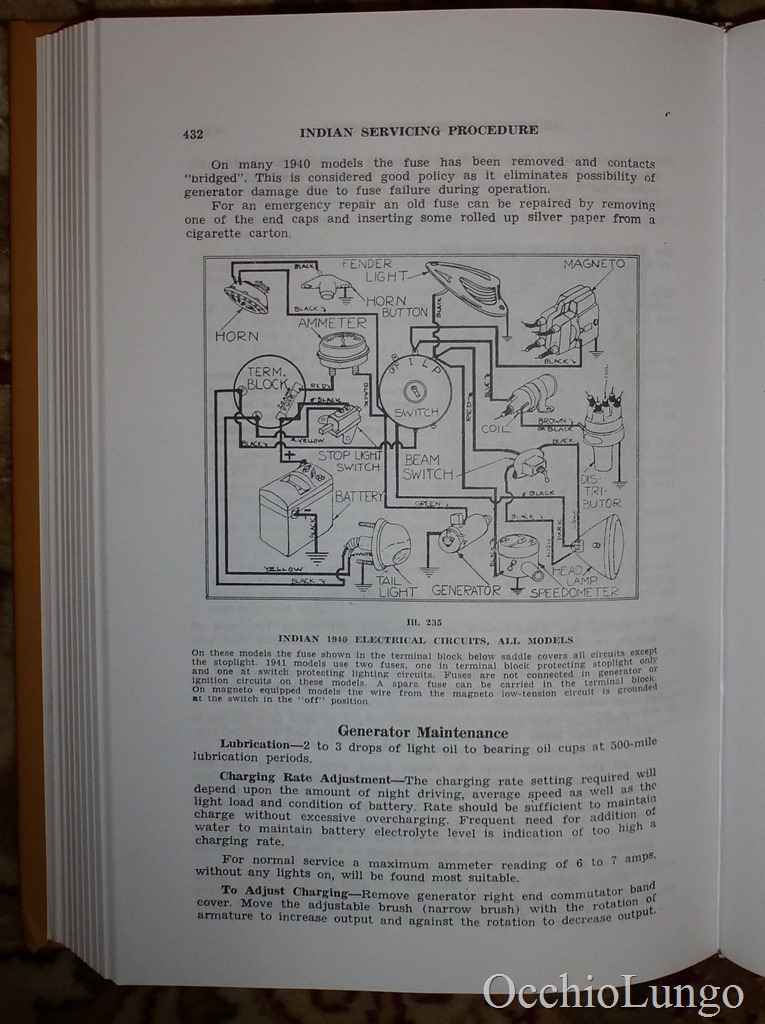

Photo located: occhiolungo.wordpress.com/
Published in 1942, the first edition of "Modern Motorcycle Mechanics and Speed Tuning" sold 4,000 copies. In all Bernie produced 7 manuals. The 7the edition of Modern Motorcycle Mechanics included information on almost every Japanese, British and American motorcycle that had been built to date. He covered the topics of motorcycle design, operation and maintenance and included chapters on specific brands. The 763 page hardcover book sold over 10,000 copies.

Because of the contribution of these repair manuals, motorcycling was able to grow in regions where mechanics/fitters were few and far between.

Many a motorcycle was kept on the road because of "Modern Motorcycle Mechanic" and today, the same is true.  His manuals are the bible for antique and vintage motorcycle repair.


Nicholson Brothers Motorcycles also employed interesting marketing tactics in their parts and sales catalogues. They give one an idea of the growth of motorcycling as seen through the retail window of one motorsport dealer.


Photo located at: www.gregwilliams.ca

In 1939, they had a map of Western Canada on the back of their catalogue and it had listed the places they had sold motorcycles to.

Blue Sky, Grande Prairie, Sexsmith and Rochester Alberta were among the places listed on the map.

The caption on the bottom of the map:

 The popularity of motorcycles is increasing in all parts of Canada and it is interesting to note that the sales of machines in outlying districts where roads are almost non-existent have been growing steadily. As well as the great sporting attractions of motorcycling, the exceptional low cost transportation and the ability to travel to points inaccessible to cars are amongst the advantages a motorcycle offers."

You see, even in its earliest of days, motorcycles, like their predecessor the bicycle, changed lives by giving people a new found sense of freedom and self reliance.

Today, Greg Williams nurtures and cares for the Modern Motorcycle Mechanics publishing.
Greg has also written a book on the history of the man behind the books called "Prairie Dust, Motorcycles and a Typewriter"

Interesting Historical Tidbits:

1910: Sturgess Cycle opens in Hamilton Ontario. They are considered to be Canada's OLDEST motorsports dealer and the OLDEST Honda dealership.

1911: Schulte's easy-start "Free-engine" model with multi-plate clutch in rear hub is available (patented by Schulte in 1908, this is Triumph's first bike with a clutch). This meant riders no longer had to run along side the bike to get it started, & then jump on! They could just ride away from a stationary position.

1911: The Manitoba Motorcycle Club is founded. Today the Canadian Hall of fame says it is the oldest MC Club in Canada and that is reported to be the 4th oldest in the world.

1927: Stanley Glanfield, took a 3.5 hp single cylinder Rudge-Whitworth on an 18,000 mile journey around the world, covering four continents.
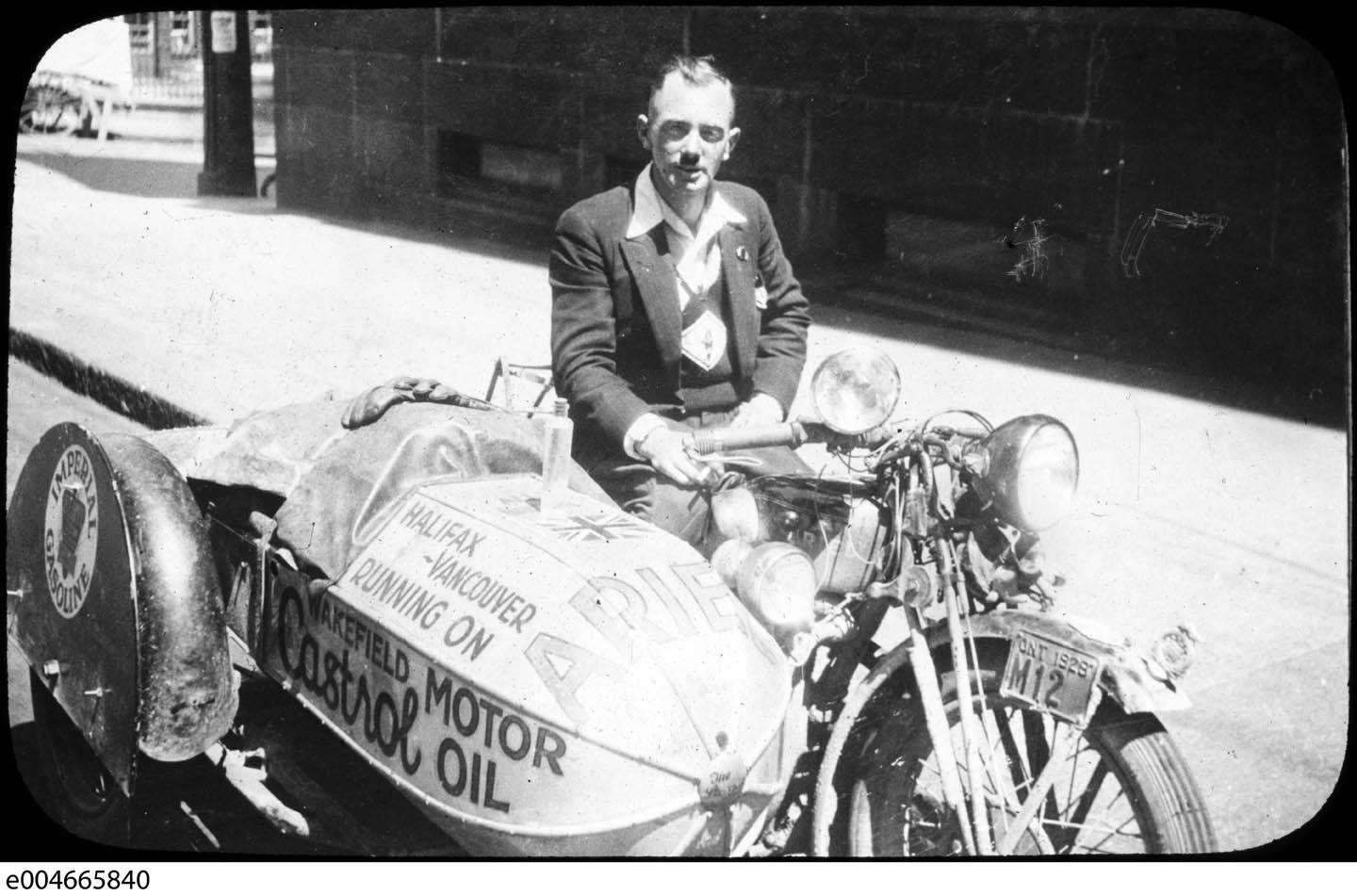
Photo located: thevintagent.blogspot.ca
1928: Graham Oates becomes the first person to traverse the breadth of Canada on a gas propelled rubber tired vehicle. The trip took him 21 days. Sponsored by Ariel Motors and Castrol Oil, Graham rode from Nova Scotia to Vancouver on a new 497cc ‘Two Port’ single-cylinder Ariel motorcycle attached to a Canadian-built sidecar – constructed by Sturgess of Hamilton, Ont.

1931-36: The Communist Party of Canada was virtually outlawed when nine of its leaders were arrested and convicted under the Criminal Code for being members of an "unlawful association"and was banned when war was declared in 1939.
 
1946:  Ducati produces its first bike, the 50cc Cucciolo.


I hope you enjoyed this instalment of "Motorcycling in Canada - a ride through our history"

Next we'll meander into Manitoba to see what was happening there....
I hope you will join us in our quest to find Canada's MOST Rider Friendly Community!
Get your nomination for your favourite community ready! Visit www.riderfriendlycontest.ca to find out more!

If you are blessed enough to be riding today, please remember to ride like everyone around you is blind and cannot see you.

Belt Drive Betty
Editor & Rider


Research for this Article:
Greg Williams
The Vintagent
Occhiolungo
Ian Chadwick
Canadian Encyclopedia
Canadian Motorcycle Hall of Fame

Disclaimer:
All data and information provided on this site is for informational purposes only. The Belt Drive Betty Blog makes no representations as to accuracy, completeness, currentness, suitability, or validity of any information on this site & will not be liable for any errors, omissions, or delays in this information or any losses, injuries, or damages arising from its display or use. All information is provided on an as-is basis.


Monday, July 06, 2015

Motorcycling in Canada - A Ride Through Our History - Part 2

Motorcycling in Canada - A Ride Through Our History - Part 2

In the 1890's bicycles were the most affordable and popular form of transportation and bicycle clubs had sprung up all over. Many a bicycle club eventually evolved into motorcycle clubs.

The bicycle itself is largely responsible for the emancipation of women. Not only did women find a new found freedom with regards to transportation but there was a sense of self reliance that the bicycle offered. Because of the dress of the day; voluminous skirts and dresses, the bicycle is also somewhat responsible for the fashion revolution of bloomers - the precursor to women's pants.


A motorcycle was considered to be an appropriate and acceptable form of transportation for women. 


You see, it was expected that, because women had taken so avidly to riding bicycles, that they would naturally gravitate towards motorcycles. In fact, in the book "Harley-Davidson - A History of the World's Most Famous Motorcycle" by Margie Siegal, there is a passage wherein the author discusses women's dress and what measures manufacturers took to ensure that women's skirts did not get caught up in the motor or final drive.


It appears that it wasn't until after World War II, that riding a motorcycle somehow became frowned upon for women, at least in some circles.


Motorcyclists played key roles in World War I & II

The Canadian Signal Corps was using Indian Motorcycles in 1917.


A group of despatch riders of the Canadian Signal Corps on Hendee motorcycles (Indian Powerplus) , Camp Valcartier, Quebec, ca 1917.  (Library and Archives Canada Photo, MIKAN No. 3336987) 


Motorcycles were used not just for communications in the military, but also for transporting ammunition, medications and extracting the wounded and the dead from the battlefield  and taking them to medical facilities.


Many women rode "despatch" during both World Wars, albeit rarely on the front lines.


The British Wrens

Outside of the roles the motorcycle played in competitive sports and military use, this economical means of transportation became a transportation staple in many regions in Canada.

The motorcycle could take you where cars, early trucks and often horse and wagon couldn't. 
It could haul things and it sprouted all kinds of small empires.
It was affordable and had a very long range for fuel, which was important as filling stations were few and far between in rural Canada.


And back in the day, the fuel range could be made very long!

In fact, American racing legend, Smokin Joe Petrali was 14 years old in 1918 when he got 176 miles to a gallon of fuel by riding his bike at an idle and won the national economy class for 30.50-cubic-inch motorcycles in the US. 

His bike? A 1914 30.50-inch (500cc) Indian Standard that cost him $35.00

I discussed in my previous article, some of the contributions to motorcycling that the Deeley family brought to British Columbia and Canada in 1914 and on into modern times, but BC was not the only place in Canada where enterprising men were impacting the Canadian motorcycling scene.

Far from it. 

All across the country there were people who impacted our community, sport, industry and country.

Let's move on to Alberta in the early 1930's...where the motorcycle, anger and determination to do the right thing started an empire.

In 1931 a very angry young Walt Healy became the Indian dealer in Calgary Alberta.

Why was 18 year old Walt so angry?


Walt Healy: www.walthealy.com
Well you see this enterprising young man had started running a delivery service at 13 years of age. 

He started first with bicycles and once he earned enough money he purchased a 1914 Douglas for $15. 

That Douglas allowed him to earn money faster and soon he owned both a Harley and and Indian side car outfit. 

So the story goes, Walt had gone to then Harley-Davidson dealer Clyde Paul and put a deposit down on the next Harley Police bike to come in. 

When he went in to collect the motorcycle he was told by the dealer, that he had sold it to someone else.  Well, young Walt said, "I want the next police rig that comes in", and again the story repeated itself. This time Clyde, had decided he was going to make the rig into a hill climber instead of selling it to young Walt. To Walt's way of thinking, this was a poor way to do business.

Walt ended up buying a 101 Indian Scout engine from Clyde for the $20 he had on deposit, and then he bought an Indian from a friend for $10. He built that motorcycle to be a hill eating, Harley eating, Clyde's pride eating machine and made sure to enter every race that Clyde did.  

Reportedly Clyde never did beat Walt.

In the meantime, Walt had gone to the Indian Dealer to buy two bikes and ended up buying the Calgary Indian dealership for $100 thanks to a friend who co-signed the note.

Between his dealership and delivery service Walt managed to eek out a living, eventually hiring his dad to wrench on bikes. The hard work and long hours paid off. Over the years Walt Healy's not only became a dealership to be reckoned with but the man himself was a force to be reckoned with.  

He was behind the motorcycle mechanics trade being officially recognized by the Alberta government.

It took him 18 years and he saw four ministers of transport go through their terms as he sought to have motorcycle mechanics recognized as a licensed trade in Alberta. 

In 1986, he received his own motorcycle mechanics licence.

As a young man of 14, Walt had subsidize his income from the delivery service by allowing other young people to ride his motorcycle.  He'd charge them 5 cents, teach them the basics and let them ride his motorcycle up and down the block but if they turned the corner and went out of sight, he'd charge them 10 cents.  

We'll that desire to teach others to ride culminated in his ‘Learn to Ride’ program.

Eventually the program turned into the Calgary Safety Council, and that evolved into what is now known as the Canada Safety Council.

Walt Healy passed away in 2002 and sadly on March 31, 2014 Walt Healy Motorsports closed for good, closing a chapter on Alberta and Canadian motorcycling history.

Walt Healy's contributions to motorcycling are many and whether you have ever heard his name or not, his influence, determination, work ethic, persistence, passion and knowledge of the motorcycle forever changed the face of motorcycling in Canada.


Interesting historical tidbits:

1911: The Toronto Police Service, Canada's first police service was also the first police service to put motorcycles into use.

1920: British Columbia became the third province to start driving on the right hand side of the road.
Ontario and Quebec were the first provinces to adopt this practise. New Brunswick, Nova Scotia and PEI followed suit shortly thereafter.

1926: The Calgary Motorcycle Club was founded by Walt Healy in 1926, and still exists today.

1937:  The first intercity, divided highway in North America opens featuring the longest stretch of consistently illuminated road in the world at that time. The Queen Elizabeth Way, named after the Queen Mum, is 139.1 kilometres in length.

1940: The Red Devils MC is founded in Hamilton Ontario

1949: Parliament passes the Trans Canada Highway Act to build a highway that would connect all of Canada, the act ensured cost sharing between federal and provincial governments. Today the Trans Canada highway is 8,030 KM's long, construction started in 1950 and the highway officially opened in 1962 and was completed in 1971 making it one of the longest national highways in the world.

1949: The Motor Maids of the Eastern Canadian District was founded, in 2007 their district became known as the Atlantic Canada District.

1949: Olds Motorcycle Sales opened on a farm near Olds AB, today we know the dealership as Turple Brothers located in Red Deer.

I hope you enjoyed this little ride down memory lane!

There is more in store for you as next time we look at Saskatchewan and it's involvement in the early days of motorcycling.


I hope you will join us in our quest to find Canada's MOST Rider Friendly Community.
It is a truly a contest of exploration, discovery and community pride. 12 communities will share in over $60,000 in marketing! 


Visit www.riderfriendlycontest.ca to find out more and start thinking of the Canadian community that you think is worthy of the title, Canada's MOST Rider Friendly Community.

If you are blessed enough to be riding today, please remember to ride like everyone around you is blind and cannot see you!

Belt Drive Betty,
Editor & Rider


Research for this article:

Greg Williams:
(http://www.gregwilliams.ca/?page_id=75 & http://www.gregwilliams.ca/?page_id=193)
"Harley-Davidson - A History of the World's Most Famous Motorcycle" by Margie Siegal
Library and Archives Canada (http://www.bac-lac.gc.ca/eng/discover/military-heritage/Pages/military-heritage.aspx)
AMA Motorcycle Hall of Fame
In Search of the Canadian Car
Ontario Ministry of Transportation and Communications, Historical Committee
Bytes Daily


Disclaimer:
All data and information provided on this site is for informational purposes only. The Belt Drive Betty Blog makes no representations as to accuracy, completeness, currentness, suitability, or validity of any information on this site & will not be liable for any errors, omissions, or delays in this information or any losses, injuries, or damages arising from its display or use. All information is provided on an as-is basis.

Monday, June 29, 2015

Motorcycling in Canada - A Ride Through Our History - Special Feature

Lesbian, Gay, Bi-sexual & Transgender Month - Also known as Gay Pride Month is almost over.
So what does the LGBT community and it's celebrations have to do with motorcycling in Canada?

The recent publicity surrounding Bruce Jenner and his becoming Caitlyn has drawn much fire from society in North America as most people today just simply don't see what Bruce, now Caitlyn has done as news.

That is the acceptance factor of today. It's no big deal.

But imagine being a Grand Prix Motorcycle Racer and struggling with your identity in the 1950's.

Canada has had some rather famous people, who are transgender, come out of the closet so to speak.

Jamie Lee Hamilton - a Vancouver politician, aboriginal people's advocate and an advocate for sex trade workers. Born in 1955 as James Arthur Hamilton, her parents were both political activists.
In 1970 she was the first youth to be treated in Canada for gender identity disorder.

Jenna Talackova - born in 1988, raised in Vancouver, she began gender transition at 14 years of age. She completed he sex reassignment surgery at 19. She is best known for her role in the 2012 Miss Universe Canada Pageant when the Canadian pageant committee attempted to disqualify her. However, Donald Trump's office issued a statement reversing the Canadian organizers decision. She placed in the top 12 of the pageant.

Alec Butler - born in 1950 as Audrey Bulter, this Cape Breton native is an award winning playwright and filmmaker.

Aaron H. Devor - born in 1951 as Holly, Aaron is an internationally respected expert on gender, sex
and sexuality who teaches at the University of Victoria in BC.

Michael, now Michelle Duff
But did you know that before most of these people were born, before they declared that they were born in the wrong body and decided to do something about it, that a Canadian motorcyclist had also done the same thing?

In fact, this motorcyclist is one of the very first persons in Canada to have their gender reassigned.

The first Canadian person whose documentation is complete and verified was Dianna (Clifford) Boileau in 1969, her reassignment was completed in 1970.


Born Michael Alan Duff in 1939, the Toronto
native married twice and had two boys and a girl.
In 1984 Michael became Michelle and her gender reassignment was completed in 1987.

Michelle went on to become an author of young adult title books, is a children's writer and a photographer.

Michelle - Michael Duff had an incredible racing career, one that spanned 14 years from 1955 to 1969. Hers is a fascinating story, one filled with exotic motorcycles on exotic tracks surrounded by equally exotic people.

At 13 she caught the bug for riding by sneaking her brother's motorcycle out of the garage.

By 15 she was racing competitively.

In 1964 she won the Belgian Grand Prix becoming the first North American to win a World Championship Grand Prix and the first rider to lap the Spa race course at 120 MPH on a 250 Yamaha.


The following video from the National Film Board, Ride for Your Life, deals with the near fatal crash Michael had in Japan in 1965 and why he wanted to get back on the track.


In spite of the fear that Michelle had that she might not be accepted by race fans or competitors, Michelle has found acceptance from both fans and colleagues.

"Make Haste Slowly" is her autobiography.

She is a captivating writer and if you love motorcycles, her story is one you'll want to delve into deeper. If you'd like to read more on her story and the glory days of Grand Prix racing in Europe, visit the references below.

If you are blessed to be riding today, please remember to ride like everyone around you is blind and cannot see you.

Belt Drive Betty
Editor & Rider

Research for this article:
zagria.blogspot.ca - A Gender Variance Who's Who
Michelle-Duff.ca
TTWebsite.com - Michelle Duff - A career with a twist
National Film Board of Canada (http://www.nfb.ca/film/ride_for_your_life/)
IJMS (International Journal of Motorcycle Studies)


Disclaimer:
All data and information provided on this site is for informational purposes only. The Belt Drive Betty Blog makes no representations as to accuracy, completeness, currentness, suitability, or validity of any information on this site & will not be liable for any errors, omissions, or delays in this information or any losses, injuries, or damages arising from its display or use. All information is provided on an as-is basis.

Wednesday, June 24, 2015

Motorcycling in Canada, A Ride Through Our History - Part 1

1895 Roper Steam Velocipede - thevintagent.blogspot.ca

Throughout the centuries, man has endeavoured to expand his world through the use of machines.

Man’s ever-innovative and inquisitive mind, coupled with his need to find new thrills and adventure, means the development of the motorcycle was inevitable. The early years of motorcycling are fascinating as they offer up some of man’s most bizarre experimental machinery!

Sylvester Howard Roper built the first motorcycle in 1868. It was powered by a steam engine, and was demonstrated at fairs and circuses.

Many modern motorcycle features, including the twist handgrip throttle control,  evolved from the innovations on this machine.

By the late 1880s, motorcycle development became influenced by the internal combustion engine that had arrived on the scene.


Hildebrand & Woflmuller developed the first production motorcycle in 1894, and theirs was the first vehicle of its type to use the term “motorcycle”.

Hildebrand & Woflmuller
Deeley Motorcycle Exhibition


Hildebrand & Woflmuller
Deeley Motorcycle Exhibition

In 1901, Royal Enfield revealed its first motorcycle; it came with a 239 cc front-mounted engine and a belt drove the back wheel.

From 1901 on, the burgeoning sport of motorcycle racing fueled innovations at a fast and furious pace and as a result, hundreds of motorcycle companies sprang up around the world.

Even Canadians got into the act of producing motorcycles.

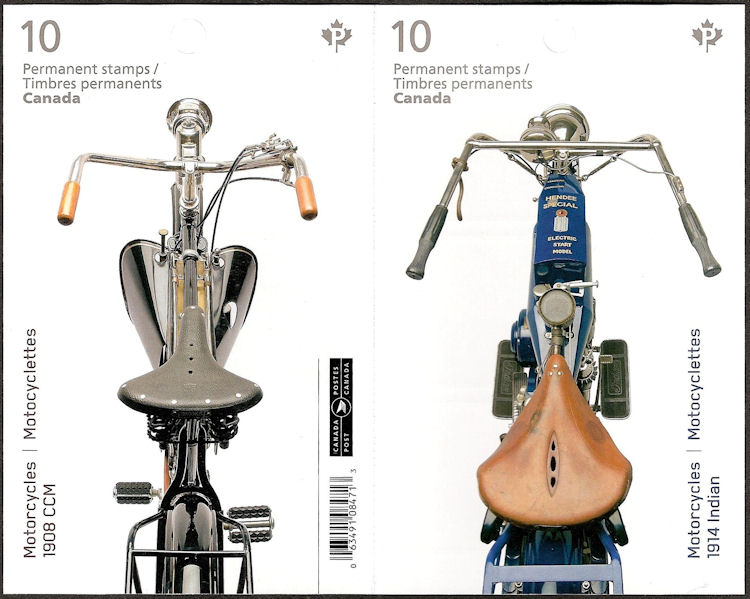
The CCM (Canadian Cycle & Motor Company) produced the Lightweight Motor Cycle from 1908 to 1911, there are only three known left to be in existence and one of them is at the Deeley Motorcycle Exhibition in Vancouver.

Canada Post

In 1912, Toronto's Mercer Street was home to the Hendee Mfg. Co production plant. (In 1928, Hendee Mfg. Co. became known as Indian)

During the First World War, motorcycles began to replace horses on the battlefield. Dispatch riders carried communications pouches and performed reconnaissance missions.

Triumph Motorcycles provided the allies with over 30,000 of its newly created Type-H bikes in World War I. Dubbed by many as the first “modern” motorcycle, the Model H by Triumph was the first motorcycle to be produced without pedals.


1922 Triumph Model H Yesterdays Antique Motorcycles

By 1920, Harley-Davidson had become the largest manufacturer of motorcycles with dealers in 67 countries, although it lost that spot for a number of years to German owned DKW in early 1930.

After World War II, as part of the reparations for the war, Harley-Davidson in the US, BSA in the UK and MMZ in Soviet Union were given the plans for the DKW RT125.

In the US the motorcycle became known as the Hummer, in the UK as the BSA Bantam and in Soviet Union as the M-1A Moskva.

Although many manufacturers in the US had sprung up to build and sell motorcycles, by 1931, only Harley-Davidson and Indian were still standing.

From 1931 until Indian closed its factory in Springfield Mass., and Royal Enfield took over the name in 1953, Harley-Davidson and Indian were fierce competitors.

From: harleyhummer.com
Here is a short list of some of the oldest American motorcycle marques:

  • Indian (1901-1953)
  • Pierce Arrow (1901-1913)
  • Curtiss (1902–1910)
  • Harley –Davidson (1903-present day)
  • Excelsior (1907-1931)
  • Iver Johnson (1907-1916)
  • Henderson (1911-1931)
  • Ace (1920-27)
  • Crocker (1936-1941)

The early 1900’s were an exciting time for the fledgling motorcycle community in Canada and Harley-Davidson Motorcycles played a huge role in that excitement and the growth of motorcycling as a sport and a pass time.

In 1907, Vancouver BC became home to the very first gas station in Canada; it was an Imperial Oil station. This would prove to play a significant role in the growth of motorcycling in Canada, and BC in particular, as the lower mainland of BC and Vancouver Island became hot beds for the sport.
  • In 1912, the Victoria Motorcycle Club became one of the first motorcycle clubs in Canada.
  • In 1913, Fred Deeley Sr. moved to Vancouver from Bromgsgrove England. In 1914 he opened a bicycle shop. He began importing BSA (Birmingham Small Arms Co) motorcycles.
  • In 1917 he began importing the Harley-Davidson motorcycle. It was around 1922 when the bicycle and motorcycle portions of the Deeley business became separate entities.
  • Fred Deeley Jr. founded the Lions Gate Motorcycle Club in 1922 and took over operations of the motorcycle division of Fred Deeley Motorcycles in 1925. Today the Lion’s Gate Motorcycle Club is known as the Greater Vancouver Motorcycle Club.
  • In 1935, 15-year-old Trev Deeley joins his father’s business as an apprentice mechanic.
  • In 1953, he takes over the business. Today, Trev Deeley Motorcycles is the fourth oldest Harley-Davidson dealer in the world.
Without a doubt, motorcycling in Canada would not have evolved into what it has today if it had not been for the Deeley’s, Fred Sr., Fred Jr. and Trev.

Some historical tidbits on the expansion of motorcycling in Canada:
  • 1919, the first retail dealership in Alberta opens up in Edmonton
  • 1936, Prairie Harley-Davidson opened up in Regina Saskatchewan under the helm of Grant Budd.
  • 1945, London Ontario becomes home to a Harley-Davidson dealership thanks to Percy Poole.
  • 1949 Laurent B. Groulx opened Pont-Viau Motorcyclettes in Ville de Laval, Quebec, Quebec’s first Harley-Davidson dealership.
  • 1969 was a year that would change many things in the Canadian Motorcycle Community. It was the year that Honda Motorcycles officially entered the Canadian market!
  • 1973, both Yamaha Motors Canada and Suzuki Canada are founded.
  • 1973 is also the year that Deeley Harley-Davidson became the official importer and distributor of Harley-Davidson motorcycles in Canada
I hope you enjoyed this little history lesson.


I also hope you will join us as we begin the quest to find Canada's MOST Rider Friendly Community.
Community Futures of Alberta, 
Belt Drive Betty Media, EastLink TV and a whole host of motorcycle media sponsors have gotten together to create over $60,000 in marketing packages to be shared by 12 communities!

The Grand Prize is a $35,000 marketing campaign!

It truly will be a contest of Exploration, Discovery & Community Pride! 


Belt Drive Betty
Editor & Rider


Resources for this article:
The Vintagent
Wikipedia
Wilson, Hugo (1995). The Encyclopedia of the Motorcycle. Dorling-Kindersley
Deeley Harley-Davidson Canada
Hope 1842 dot Com
Harley Hummer dot Com
Honda Canada
Yamaha Canada
Suzuki Canada
Ian Chadwick dot Com
Canadian Motorcycle Hall of Fame
Allan Johnson, CVMG
Terry Rea, Motorcycle Historian


Disclaimer:
All data and information provided on this site is for informational purposes only. The Belt Drive Betty Blog makes no representations as to accuracy, completeness, currentness, suitability, or validity of any information on this site & will not be liable for any errors, omissions, or delays in this information or any losses, injuries, or damages arising from its display or use. All information is provided on an as-is basis.


Sunday, June 21, 2015

Darren "Willy" Williams, a good friend, father, husband, son and CAV Member - gone from us.

Being Belt Drive Betty means I get to know, ride with and care for a lot of people.
It also means that often times when tragedy strikes, I have to say goodbye to someone I loved and cared about.

Today I, along with my brothers and sisters from CAV mourn the passing of Darren "Willy" Williams.

He and 7 of his brothers were riding in Picton County Ontario when a Mazda Miata crossed the centre line and centre punched three of the 8 bikes, 2 riders were killed instantly and one is in critical condition.

Darren was one of the riders who was killed, the other rider who died, his name has not yet been released and neither has the name of the person in ICU. Next of kin need to be notified.

Here is what is in the news about the crash: http://www.intelligencer.ca/2015/06/21/fatal-motor-vehicle-collision-in-prince-edward-county


Tracey, Darren's wife and Alisha and Michael, his children are in shock needless to say.

Darren had just become a grandpa for his first time and he so loved his little man Aiden. 
He only got enjoy being a grandpa for about 11 months.


At the 74th Crusaders Club House

Darren was the kind of friend you could call out of the blue and he always made time for you. I had first met him at the Wharf Rat Rally in Digby Nova Scotia in 2011.

I was blessed to spend some quality time with Darren in Greenwood NS and rode with him to Yarmouth in the driving down rain in 2013 on my Military Support Conga. 


We had stopped into the 74th Crusaders clubhouse to say hi just as the rain started.  When we made it to Yarmouth, Willy and I shared some time with a couple of the young folks who helped fundraise for the Yarmouth Memorial.

Trying some Tomato wine at the Yarmouth Farmers Market
The next morning, Joe and Willy took me to the memorial and then Joe and his wife Jo, Willy and I went the the farmer's market in Yarmouth - it was so foggy that Willy couldn't head back to Greenwood until mid afternoon. It was a wonderful time, one that I will forever carry in my heart.


He had given me some very special veteran's vest extenders, they were special before his life ended, but now they are just that much more special. I will always wear them with pride and remembrance.


A special gift made even more special

My heart breaks for my CAV family and the families of those affected by this horrible crash.
Please lift a prayer for willy's family and friends....

As soon as we have information on the other rider who passed and the rider in ICU, I will let you know.

It's father's day today. Look at that grumpy old man you call dad and hug him with all your might and remember to say I love you, with meaning and do it often because you never know when it will be your time to leave this world.


Darren, Jo and Joe at the Yarmouth Farmers Market


Jo, Joe and Willy at the Stanley Lobster Company


I miss you dad - Happy Father's Day
My dad, Jim McColeman at 8 Wing Trenton


Belt Drive Betty
Editor & Rider

Disclaimer:
All data and information provided on this site is for informational purposes only. The Belt Drive Betty Blog makes no representations as to accuracy, completeness, currentness, suitability, or validity of any information on this site & will not be liable for any errors, omissions, or delays in this information or any losses, injuries, or damages arising from its display or use. All information is provided on an as-is basis.

Saturday, June 20, 2015

So what the hell is Belt Drive Betty Media anyway....

I have been asked by the brand new sales people that I am in the process of training "What the hell is Belt Drive Betty Media anyway?

Belt Drive Betty Media started out as The Busted Knuckle Chronicles, a little black and white newspaper meant to serve the North Peace regions of Alberta and BC. It was packed with event information, something that 14 years ago was sorely missing on the internet or anywhere else.

Over the years, through listening to the riding community and what they wanted for tools, information and support, we began creating things like the Never Ride Alone Program, taking over the Canadian Riders Support Network, building a Rider Friendly Phone Book, Apps and a whole lot more!

Yes, since 2003, Belt Drive Betty Media has evolved into a full fledged Media Company offering a wide array of services and properties to get one's message out on or find the information you are seeking.

Our Web Sites:


Belt Drive Betty Media on Facebook:

Belt Drive Betty’s Beaver Road Trip Rita

Veteran’s Advocacy Work

You-Tube:
Ride Like a Local  - also on EastLink TV
Motorcycle Travel Channel – not yet active
Belt Drive Betty on Trip Advisor
Belt Drive Betty @ Northern Horizon

Twitter:

Linked In:

Belt Drive Betty on Google Plus
Ride Like a Local on Google Plus
Motorcycle Travel Channel on Google Plus – not yet active
Belt Drive Betty on Pinterest
Belt Drive Betty on Instagram
Belt Drive Betty on Belt Drive Betty dot com

Belt Drive Betty on Blogger

We have many blogs that I am now looking for riders to share their stories on.


Oh and let's not forget our App available for Download in the Google Play Store, by QR Code and soon to be in the Apple App Store.

And our phone book's PDF Download

Until today, putting this list together for my sales reps, I never really realized just how much territory we cover! 

Interested in networking with us?

Membership in the Rider Friendly Business Association start at $129.95 per year and offers a host of benefits to the member business. 


Be you a Small Business, a Travel Destination Office or District Marketing Office, National Brand/Chain or an Event Coordinator, we have membership levels and advertising packages to suit your needs!

If you are interested in working with Belt Drive Betty Media: 

In Eastern Canada, contact Chantal Senecal for more information
In Alberta, contact Marnie Thibodeau
In BC and for National Advertising contact Nanette Jacques

If you currently work with us, or have been recommended to us, you can expect, over time to have one of these lovely ladies reach out to you!

Have a fabulous day and if you are blessed enough to be riding today, please remember to ride like everyone around you is blind and cannot see you.

Belt Drive Betty,
Editor & Rider


Disclaimer:
All data and information provided on this site is for informational purposes only. The Belt Drive Betty Blog makes no representations as to accuracy, completeness, currentness, suitability, or validity of any information on this site & will not be liable for any errors, omissions, or delays in this information or any losses, injuries, or damages arising from its display or use. All information is provided on an as-is basis.